The bill that only goes one way
Stop being the utility's biggest customer. Become its partner.
Power is the one line item on your P&L that climbs every year with no check and balance — while the electrical backbone under your docks and sites keeps getting older. GridLynQ flips that relationship in steps: we fund the upgrade, put storage on your property, and turn your marina into the energy warehouse the utility wants to pay, instead of the peak-hour load it wants to charge.
Welcome
A warm welcome from the GridLynQ marina team
We work with working waterfronts. Your marina keeps boats fuelled, hauled, charged and in the water — and every one of those jobs runs on power that costs more each season. We pay for the upgrade under your docks, put a battery on your property, and share what the grid pays back. Nothing changes for your slip holders except better, faster power.
- Every year
- Your power bill goes up — and nothing on your side pushes back
- Peak hours
- When the grid charges the most and your dock draws the most
- 0 CapEx
- GridLynQ funds the upgrade; you contribute the site, not cash
From the founder
Why Kyle Ritchie built GridLynQ
Civil engineer, builder, then the waterfront — and the Ritchie Principles and Compass that steer the company. Ninety seconds.
Meet the founder
The marina credit
A harbour full of boat batteries is a neighbourhood's back-up power.
Every electric boat carries a large battery that sits idle at the dock. GridLynQ puts metered pedestals and a battery block on the marina, schedules those packs so they charge when the grid is easy and give power back when the region is straining, and turns the value that creates into a credit — shared with the boat owners, the host property and the town around it.
- Boat owners earn from a pack that would otherwise sit still
- The marina gets the dock electrical upgrade without the capital
- The town gets a stronger local grid and a share of what the credit funds
Proposed work. No site is built, energised or under contract, and every figure we publish is modelled.
Where the money is going
Your power bill is the one expense nobody is negotiating.
A cost with no ceiling
Rates, delivery charges and demand ratchets move in one direction. Nothing on your side of the meter negotiates back — you simply pay whatever the tariff says this year.
Peak pricing punishes your busiest hours
Summer evenings, haul-out weekends, full docks. Exactly when you draw the most is exactly when power costs the most, and one spike can set your demand charge for a year.
An ageing micro grid underneath it all
The service, panels and dock feeders were sized decades ago. Every season adds load they were never designed for, and the upgrade bill lands on you.
Storage changes who has leverage
With a battery block and metered pedestals on site, you shave your own peaks first and sell what is left. The utility starts treating your property as capacity to pay for, not load to price up.
Flipping the script
A stepped path from paying the grid to being paid by it.
Nothing here asks you to write a cheque or gamble on a technology. Each step protects more of what you are already spending, and each one earns the right to the next.
Step 1
See the bill clearly
We read your last 12 months of utility statements and meter data, and separate energy from delivery, demand and peak-window charges. You find out which hours are actually costing you the money.
Step 2
Modernize the micro grid — on our capital
Service, panels, dock feeders and metered pedestals are upgraded and permitted by GridLynQ under a long-term site lease. No capex from the marina, and the ageing backbone problem stops being yours.
Step 3
Put storage behind your meter
A containerised battery block charges when power is cheap and covers your load when it is expensive, so peaks are shaved before the utility ever sees them. Capacity grows in standard prefabricated blocks, added one at a time as demand grows.
Step 4
Sell capacity back at prime time
With storage and V2G-ready vessels on site, the property can discharge into the grid during the exact windows the utility is short. Peak hours change from your worst cost to your best earning hour.
Step 5
Become the utility's energy partner
Your site joins an aggregated portfolio of prefabricated battery blocks the utility can dispatch. That is a different conversation than being a large customer — you are the storage warehouse they need to cater to.
Marinas & boatyards
Storage slips that earn between voyages.
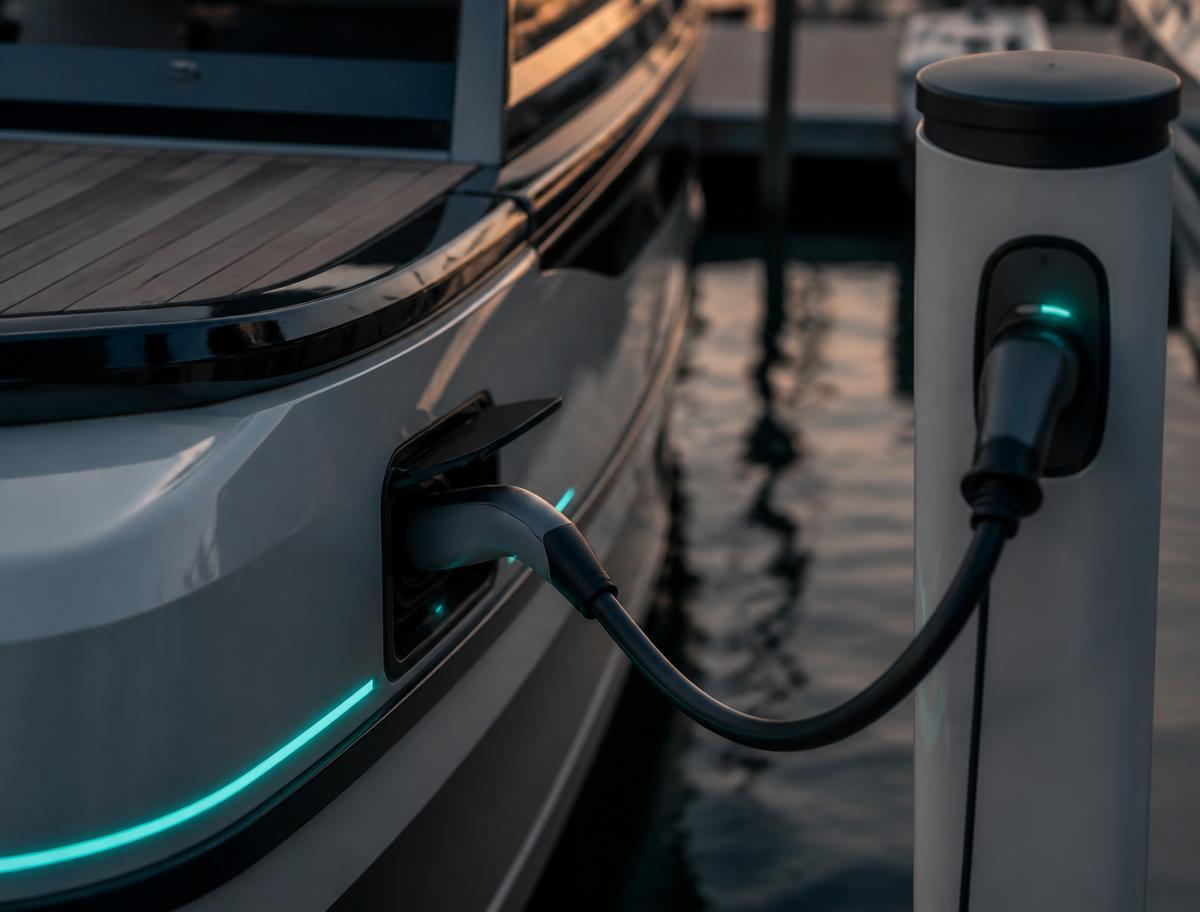
Electric and hybrid vessels spend most of the year tied up. GridLynQ upgrades your shore power into metered, bidirectional pedestals so those battery banks support the grid while your boats sit safe in their slips.
- Marine-grade bidirectional pedestals for wet slips, covered slips and dry storage racks
- Per-slip submetering ends flat-rate electrical losses and bills usage accurately
- Load management protects your dock panel as more slips electrify
- A V2G slip tier your members will pay a premium for, plus energy credits back to owners
- Winter and haul-out seasons become your highest-value dispatch window
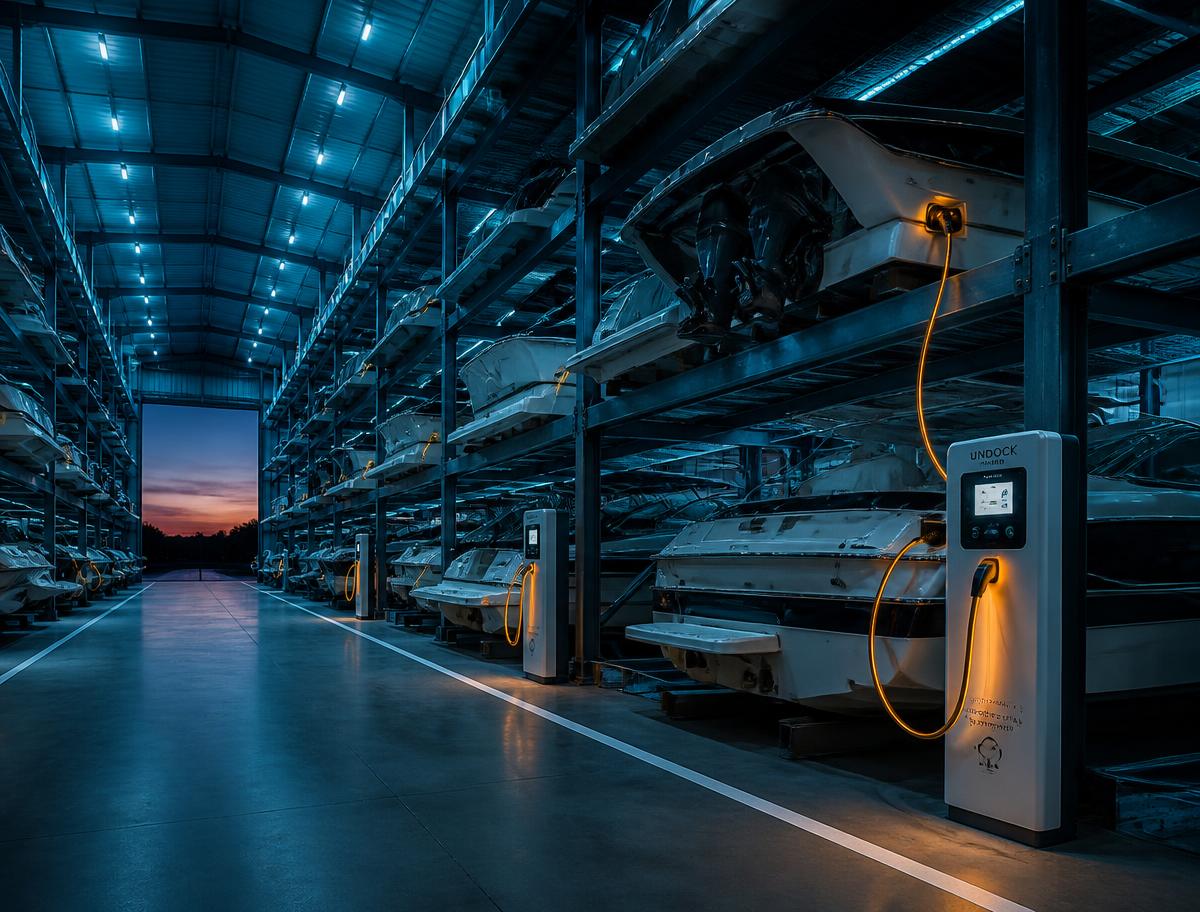
Boat storage facilities
Dry stack and indoor racks full of idle batteries.
A dry stack building, indoor rack barn or trailer yard holds dozens of electric and hybrid vessels that go untouched for months. GridLynQ brings metered, bidirectional power to the racks so that stored fleet becomes dispatchable capacity instead of dead weight on your insurance schedule.
- Rack-level and row-level bidirectional circuits for dry stack, indoor barns and outdoor trailer yards
- Maintenance charging keeps house banks healthy through long storage terms, monitored remotely
- Storage contracts sit still for months — the longest, most predictable dispatch window in the industry
- Per-unit submetering turns charging from an absorbed cost into a billable storage add-on
- Load management and thermal alerts sized for enclosed, high-density lithium storage
- Forklift and launch-day loads scheduled around dispatch so operations never wait on power
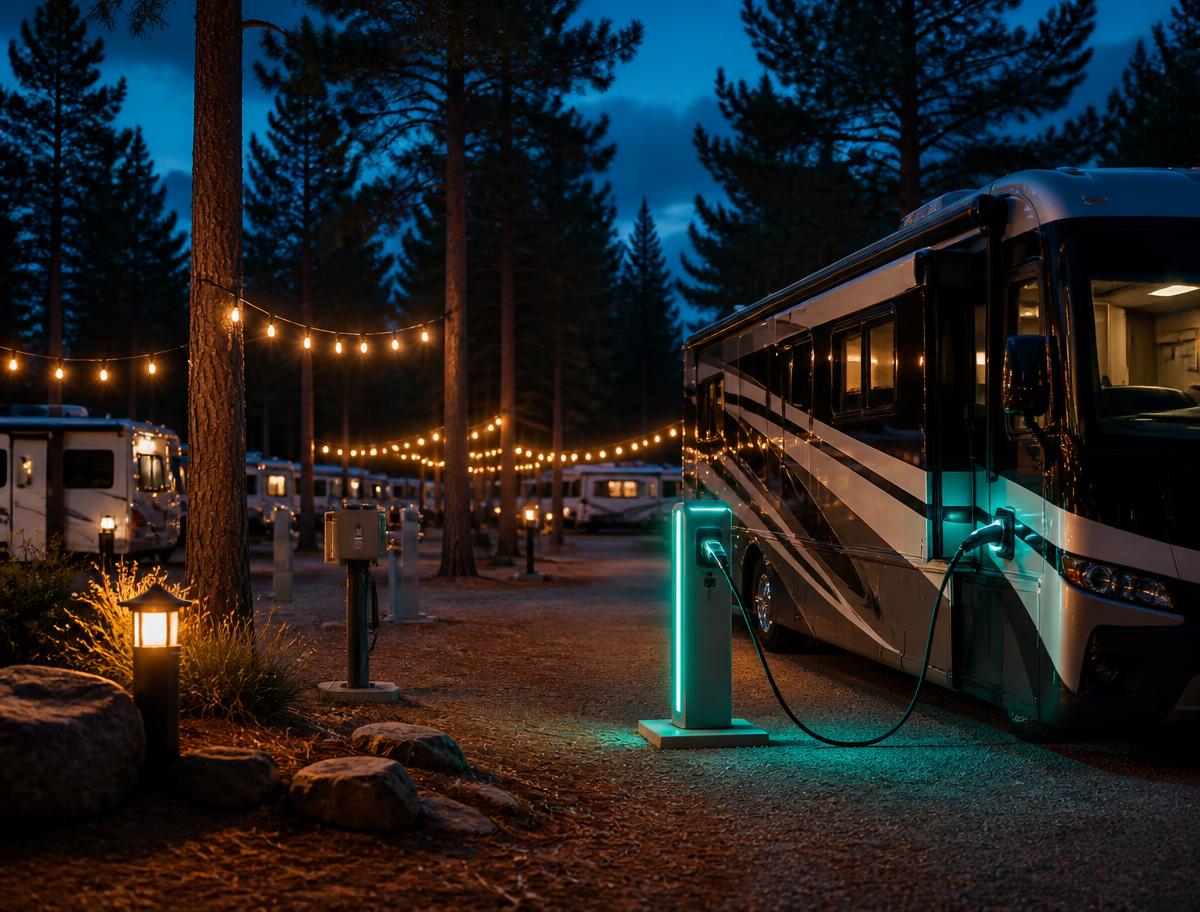
Campgrounds & RV resorts
Full-hookup sites, upgraded into grid capacity.
Full-time residents keep their rigs connected year-round and transient guests arrive expecting real charging. One GridLynQ build serves both: reliable metered power for every stay, and dispatchable capacity from the rigs that never leave.
- 50A pedestal retrofits with V2G-ready bidirectional units on long-term loops
- Full-time sites deliver predictable, enrollable capacity month after month
- Transient loops earn on metered charging and reservation-linked billing
- Stop absorbing electricity in the site rate — meter it, bill it, or credit it back
- Charging availability becomes a booking advantage for EV-towing guests
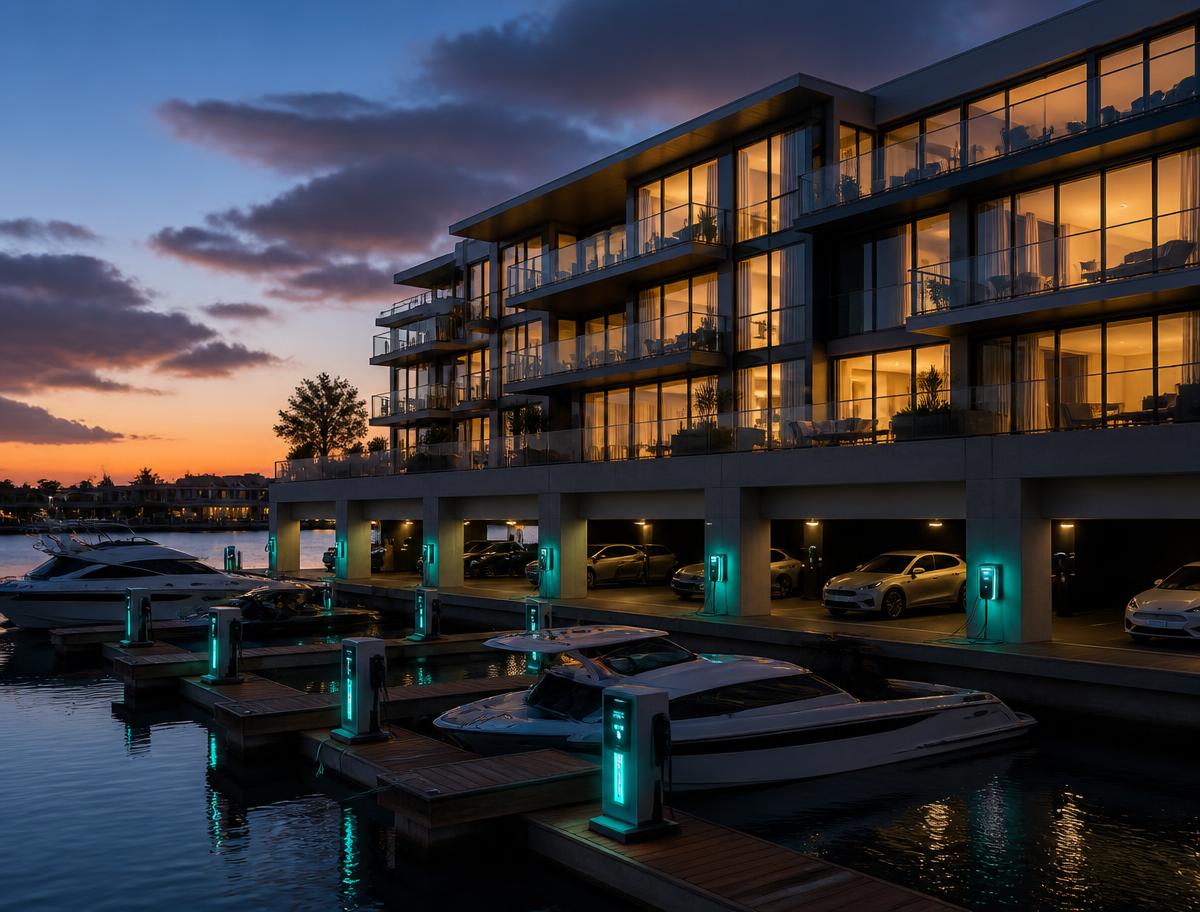
Waterfront condominiums
Slips, homes and one shared energy asset.
A condominium community with private slips already owns the two things a microgrid needs: batteries at the dock and load in the building. GridLynQ links them, so the association trims peak demand every month and keeps critical systems alive when the grid drops.
- Vessel and vehicle batteries discharge into common-area load during peak pricing windows
- Outage support for elevators, pumps, lighting, gates and common areas without a diesel generator
- Per-owner submetering so charging is billed to the unit, not buried in association dues
- Board-ready reporting on demand savings, resilience hours and program revenue
- Phased builds that fit reserve-study cycles and existing dock and garage electrical service
60-second pre-check
Find out if a site assessment is worth your time
Five questions about your property. We tell you straight away whether your slips, sites or units are a fit for V2G — no contact details required.
Should you request a site assessment?
0/5 answeredFive quick questions. No contact details needed — you get an answer on this page.
Answer all five questions to see whether an assessment makes sense.
Marina sign-up
Apply to host a GridLynQ hub
Tell us about your marina and it goes straight into our host pipeline — a site lead reviews the slips and shore power, sends the host package, and proposes a walkthrough.
Host sites
Start your project
Sign up as a host site — marina, boat yard, storage facility or campground — and we come back with the storage-slip and pedestal plan that fits your property.
How it works
From shore power to grid asset in four steps.
1. Site & service audit
We map your slips or sites, existing pedestals, panel capacity, utility tariff and available interconnection headroom.
2. V2G-ready build-out
Bidirectional-capable pedestals, submetering and load management installed slip by slip or loop by loop, phased to your season.
3. Grid enrollment
We enroll the aggregated capacity in the utility or ISO programs your region supports, and handle the telemetry and compliance.
4. Revenue & reporting
Tenants see their own usage and credits; you see per-site earnings, uptime and settlement in one dashboard.
Deployment model
Hub and spoke, phased to fit your site.
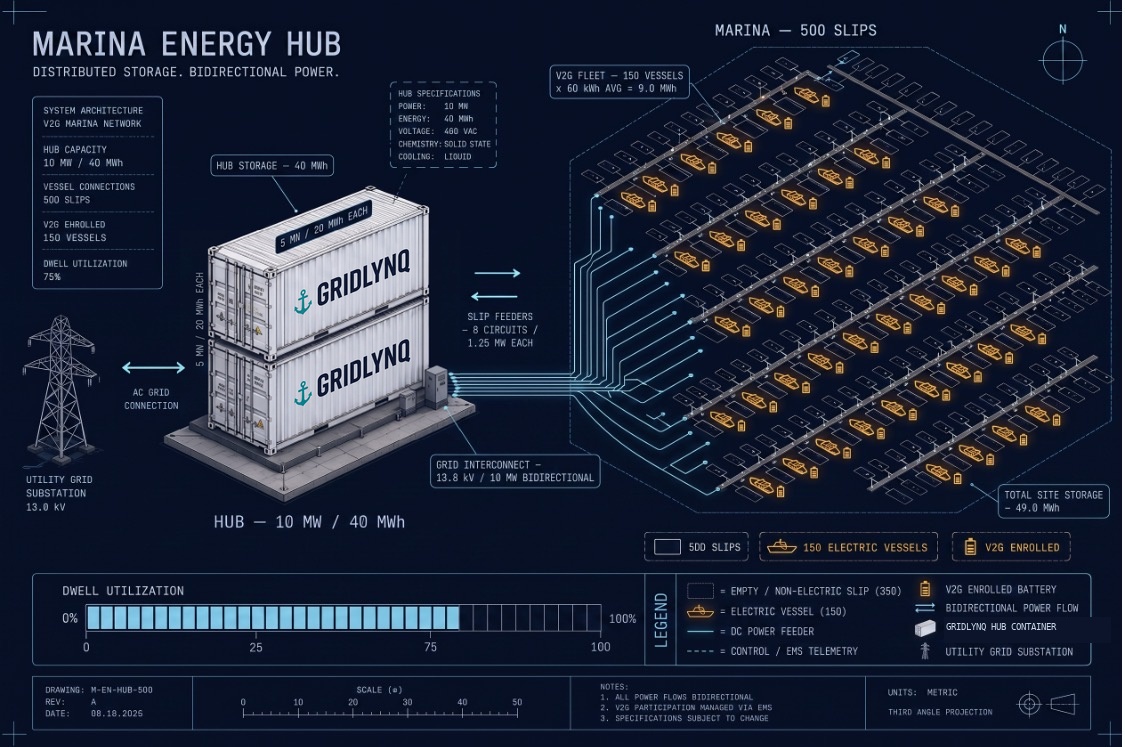
GridLynQ does not scatter one-off chargers and hope they add up. We anchor each region with a battery boost hub built from standard prefabricated blocks, added one at a time as demand grows, then link surrounding marinas, boat storage yards, campgrounds and waterfront condominiums to it as spokes. The result is a single, measurable grid asset that utilities and local and state authorities can review, approve and count on — and a build path that repeats cleanly.
Interactive hub & spoke model
Add prefabricated battery blocks and watch how capacity flows to each connected property.
Slip pedestals carry bidirectional feeders. Enrolled vessel batteries dwell at the dock and answer hub dispatch without the operator touching a thing. In support mode the hub pushes stored energy out to this property during peaks and outages.
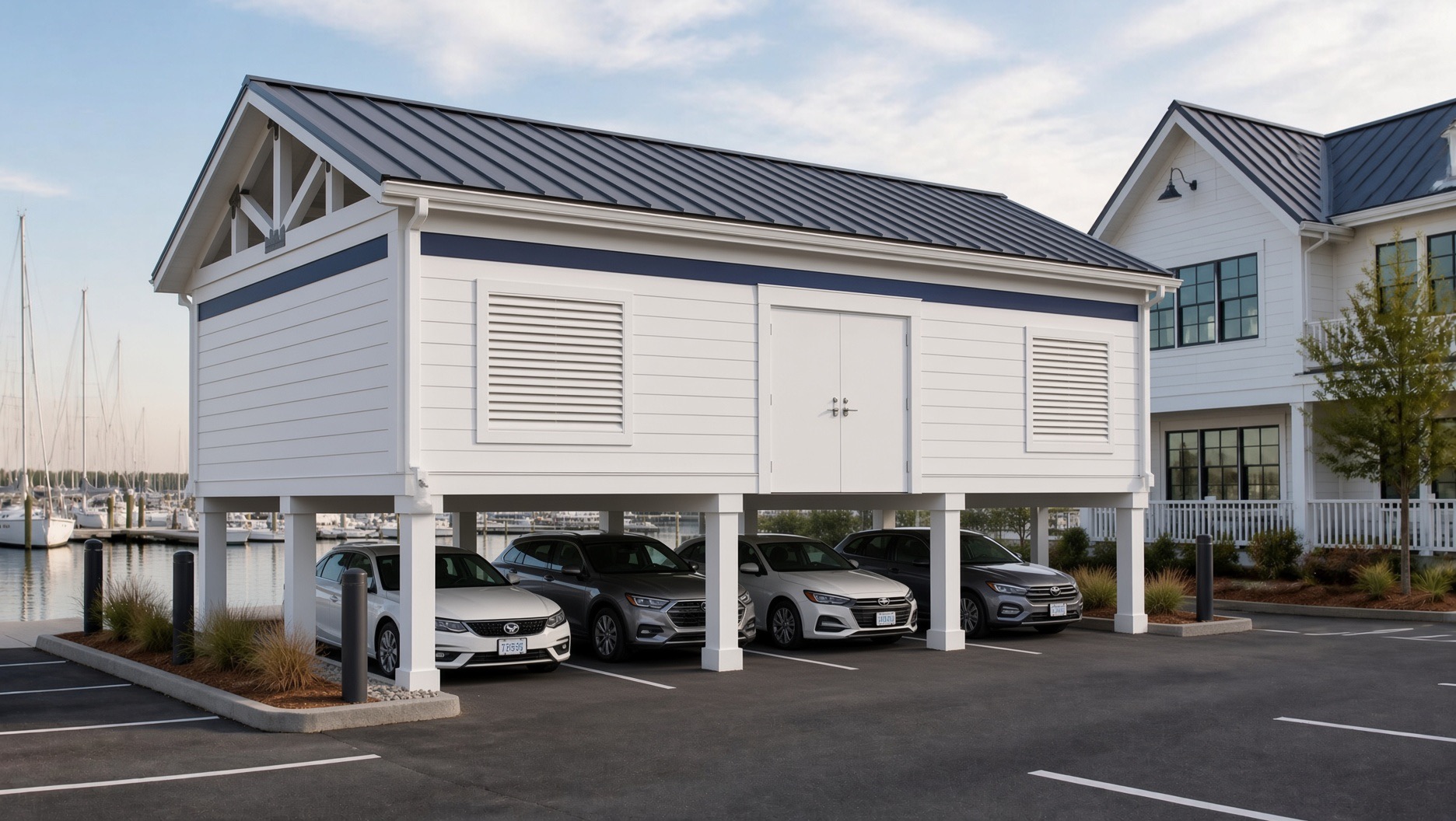
Coastal clapboard enclosure — elevated deck
Standard shipping-container modules wrapped in white clapboard and lifted on piers, so the hub reads as a marina outbuilding and keeps equipment above flood elevation.
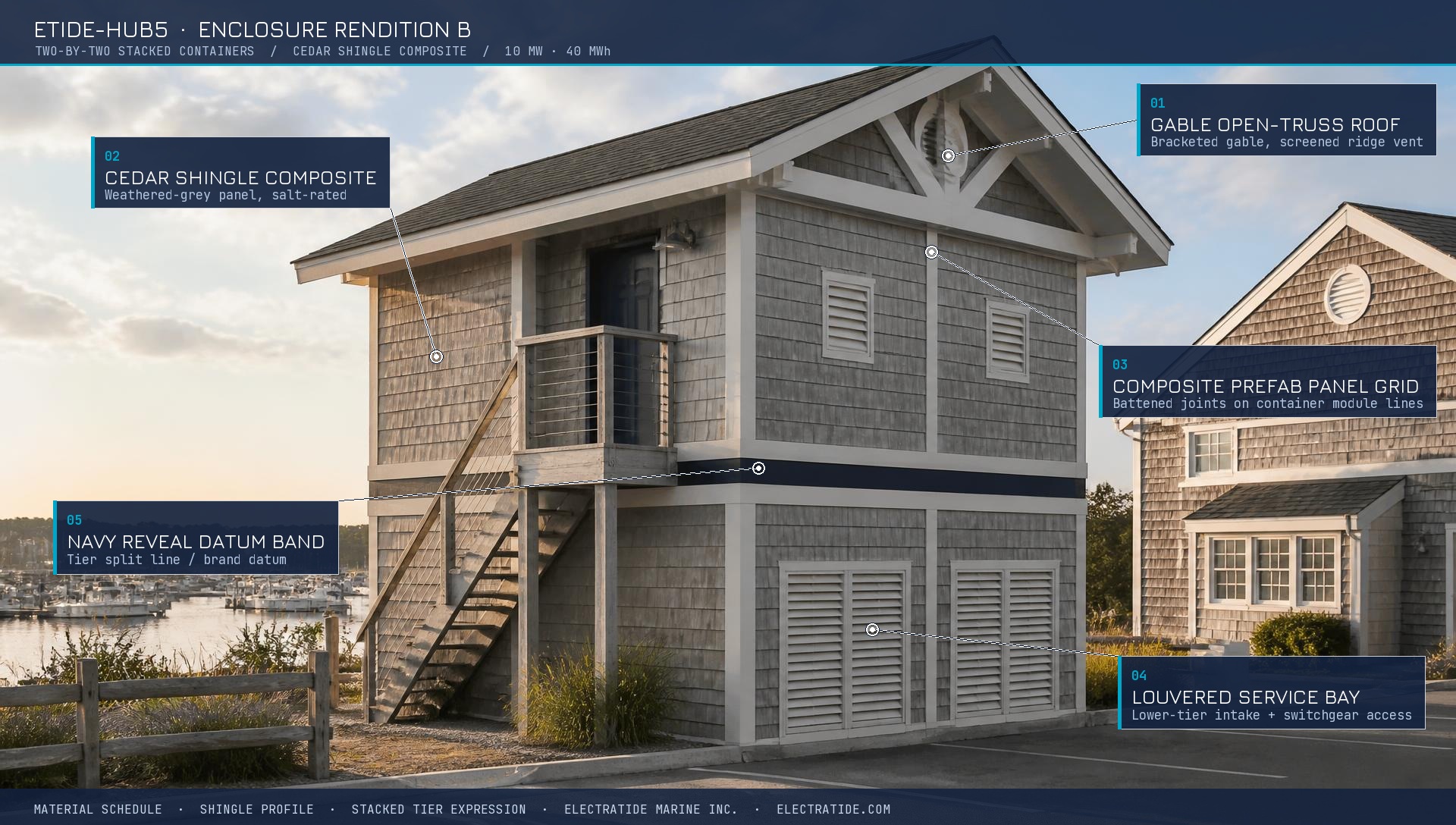
Cedar shingle enclosure — two-by-two stacked
A stacked, multi-block enclosure in salt-rated cedar shingle composite, with a louvered lower-tier service bay for intake and switchgear access.
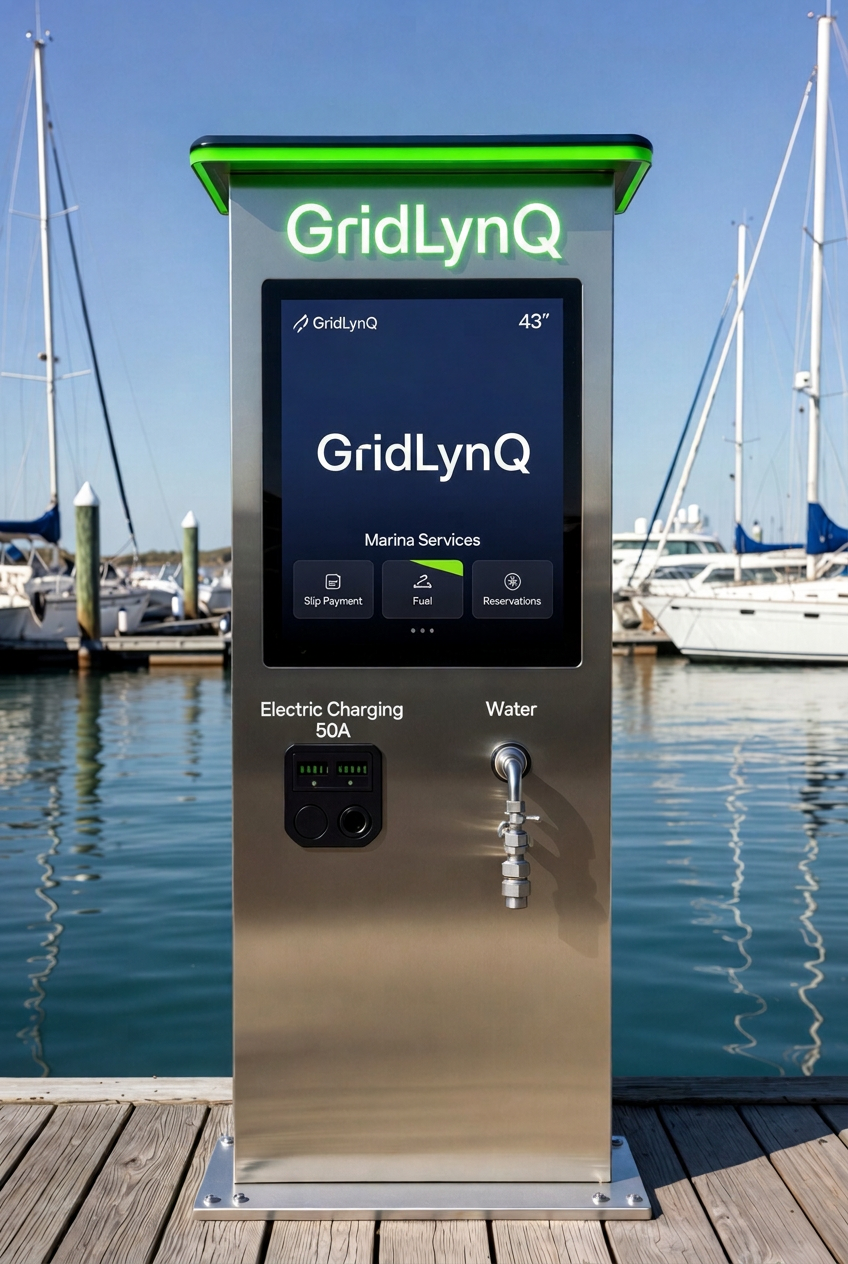
Dockside service pedestal — stainless
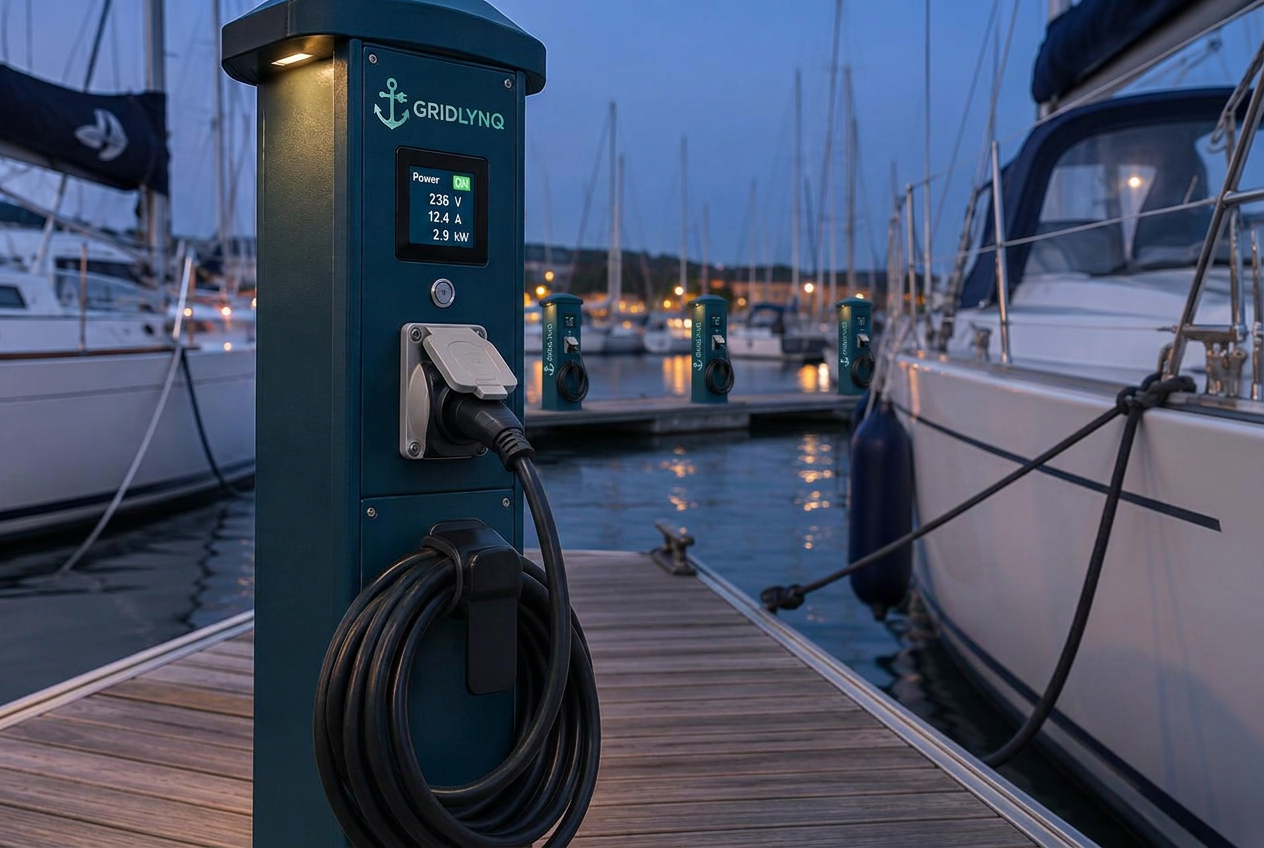
Brushed stainless pedestal with a 43-inch touchscreen for slip payment, fuel and reservations, 50A charging and metered water at every berth.
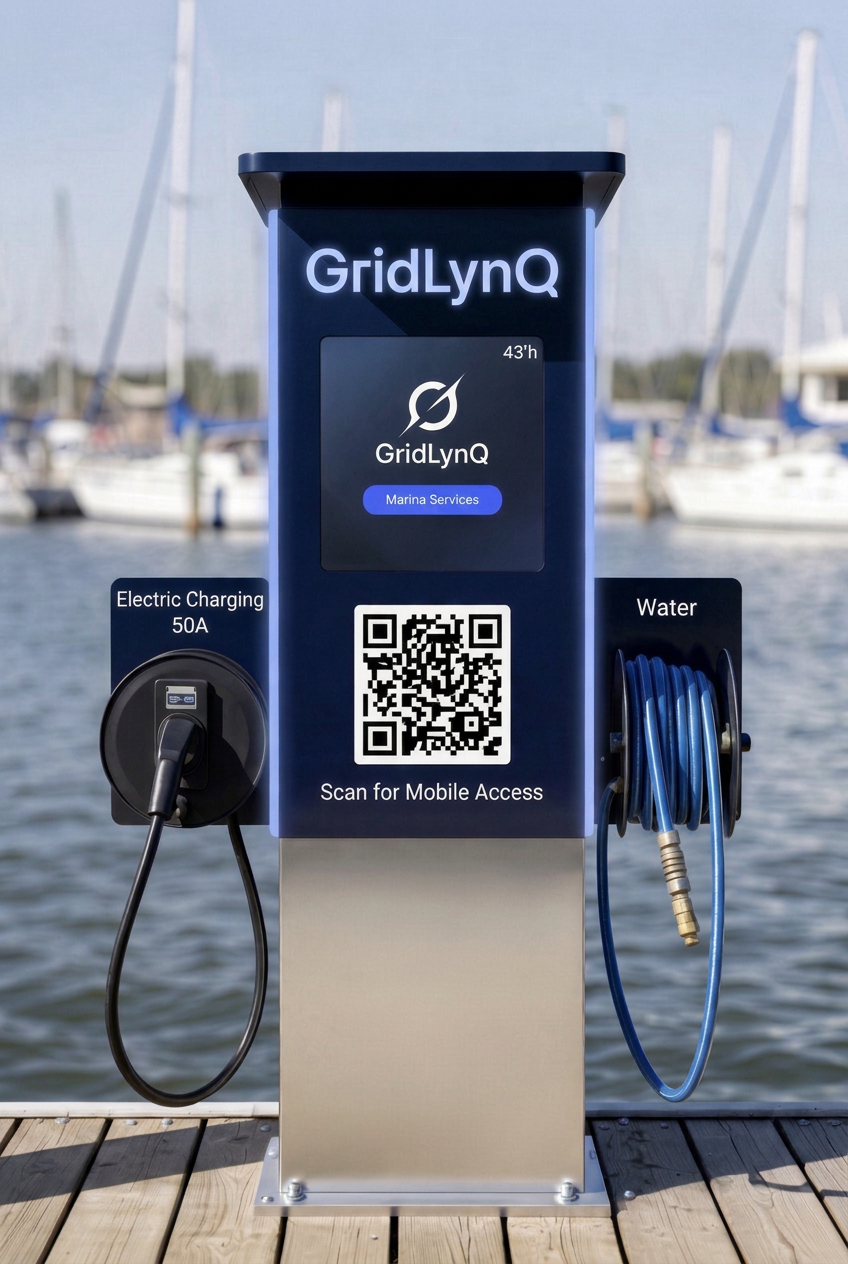
Dockside service pedestal — midnight
Midnight housing with a QR mobile handoff, tethered 50A charging cable and a hose reel wing — the same platform in a lower-profile finish.
Phased, right-sized deployment
Every deployment uses standard prefabricated blocks, added one at a time as demand grows. It is a build path utilities already model, finance and interconnect — quick to permit, and sized to matter on the feeder.
One hub, many spokes
The hub carries the stationary battery boost asset and grid interconnection. Marinas, dry stacks, campgrounds and condo docks around it become spokes, aggregating vessel and rig batteries behind a single point of grid visibility.
Built for approval
A metered hub with live telemetry gives utilities, local councils and state programs something concrete to evaluate — location and dispatch behavior — instead of a scattered pilot.
Repeatable expansion
Once a hub is energized and performing, the next block lands on proven interconnection studies and an existing regulatory record, so each increment is faster and cheaper than the one before.
Phased
Blocks added one at a time, each sized for standard interconnection review
1 : many
Spoke properties aggregated behind each hub's grid connection
Grid asset
Registered, metered capacity — not an unmodeled cluster of chargers
Deployment and sizing specification
Block capacity and geometry, hub and spoke layout, feeder design, interconnection voltage and the phased build-out schedule for your site.
- Block capacity and geometry for your property
- Hub and spoke layout and feeder design
- Interconnection voltage and phased build-out schedule
Full ROI and cashflow model
Ten-year cashflow, revenue-stack assumptions, sensitivity ranges and the per-segment unit economics behind the headline numbers.
- Ten-year cashflow by revenue stream for your site
- Capital and install build-up for each prefabricated battery blocks
- Sensitivity ranges on the levers that move payback
- Segment-specific adoption and demand assumptions
2-minute check
Is your property V2G-eligible?
A few questions about your property type, slip and site count, electrical service and goals. You'll get a tailored build recommendation before you talk to anyone.
Step 1 of 8
What kind of property do you operate?
What the host gets
You provide the site. We fund, build, own and stand behind the system.
GridLynQ does not sell equipment and walk away. We finance and install the system on the ground we energize, we operate it, and we carry full responsibility for battery performance and replacement. Agreement structure and commercial terms are walked through privately during your site assessment.
We fund and build it
GridLynQ pays for the equipment, the interconnection and the electrical work. There is no capital ask, no borrowing and no line item in your budget.
You earn from day one
The footprint we energize earns for the property from the moment the system is live, alongside a modernized electrical service you did not have to pay to build.
Performance is our obligation
GridLynQ stands behind battery performance against contracted capacity and availability targets. If a block underperforms, we make it right — not the host.
Replacement is our cost
Every cell, inverter and control system is ours to monitor, maintain and replace at end of life. Zero capital calls, zero disposal liability for the host.
Battery performance, safety monitoring, warranty administration and end-of-life replacement and recycling sit with GridLynQ. Agreement length, renewal structure and the rest of the commercial terms are reviewed with you directly, under confidentiality.
If the relationship doesn’t work — your exit termsQuestions
Straight answers for operators.
Do our tenants need new boats or RVs?
No. GridLynQ hardware charges any standard vessel or rig today, and adds bidirectional capability for the growing share of V2G-capable batteries. The site is future-proofed on day one and earns charging revenue immediately.
Will discharging drain a customer's battery?
Owners set floor limits and departure times. Dispatch never crosses the reserve they choose, and every kWh exported is logged and credited back to their account.
What does it cost to install?
We offer both owner-funded builds and revenue-share deployments where GridLynQ funds the hardware and shares program earnings. The site audit determines which fits your electrical service.
Does this work at seasonal or off-grid campgrounds?
Yes. Full-time and long-stay sites are the strongest V2G candidates because rigs stay connected. Transient loops still earn on metered charging, and solar or storage can be paired where the service is thin.
Get started
Book a V2G readiness review for your property.
Tell us how many slips or sites you operate and what your electrical service looks like, then pick a time for a 30-minute assessment call. We'll come back with a phased build plan and the revenue programs available in your region.
Prefer email? hello@gridlynq.com