Hub & spoke deployment
From site selection to a registered grid asset, in one repeatable phased deployment.
GridLynQ builds in standard, repeatable increments. One anchor property hosts a battery boost hub with the grid interconnection; nearby marinas, boat storage yards, campgrounds and condo docks connect as spokes and aggregate behind it. Below is the sequence we run on every cluster — the sizing, feeder counts and interconnection specification for your site are released with your assessment.
One block
Standard prefabricated increment, sized to fit routine interconnection review
4–8 spokes
Properties typically aggregated behind one hub connection
10–14 months
Site selection to registered grid asset on a first-in-territory hub
How the topology works
Add increments to the hub and watch the allocation flow to each spoke. Toggle the direction to see hub-to-spoke resilience support versus spoke-to-hub aggregation.
Interactive hub & spoke model
Add prefabricated battery blocks and watch how capacity flows to each connected property.
Slip pedestals carry bidirectional feeders. Enrolled vessel batteries dwell at the dock and answer hub dispatch without the operator touching a thing. In support mode the hub pushes stored energy out to this property during peaks and outages.
Architectural renderings
Illustrative design intent for a reference hub and its dockside spoke connection — exterior massing, interior equipment halls and the campus-scale topology. These are visualization studies, not stamped construction documents.
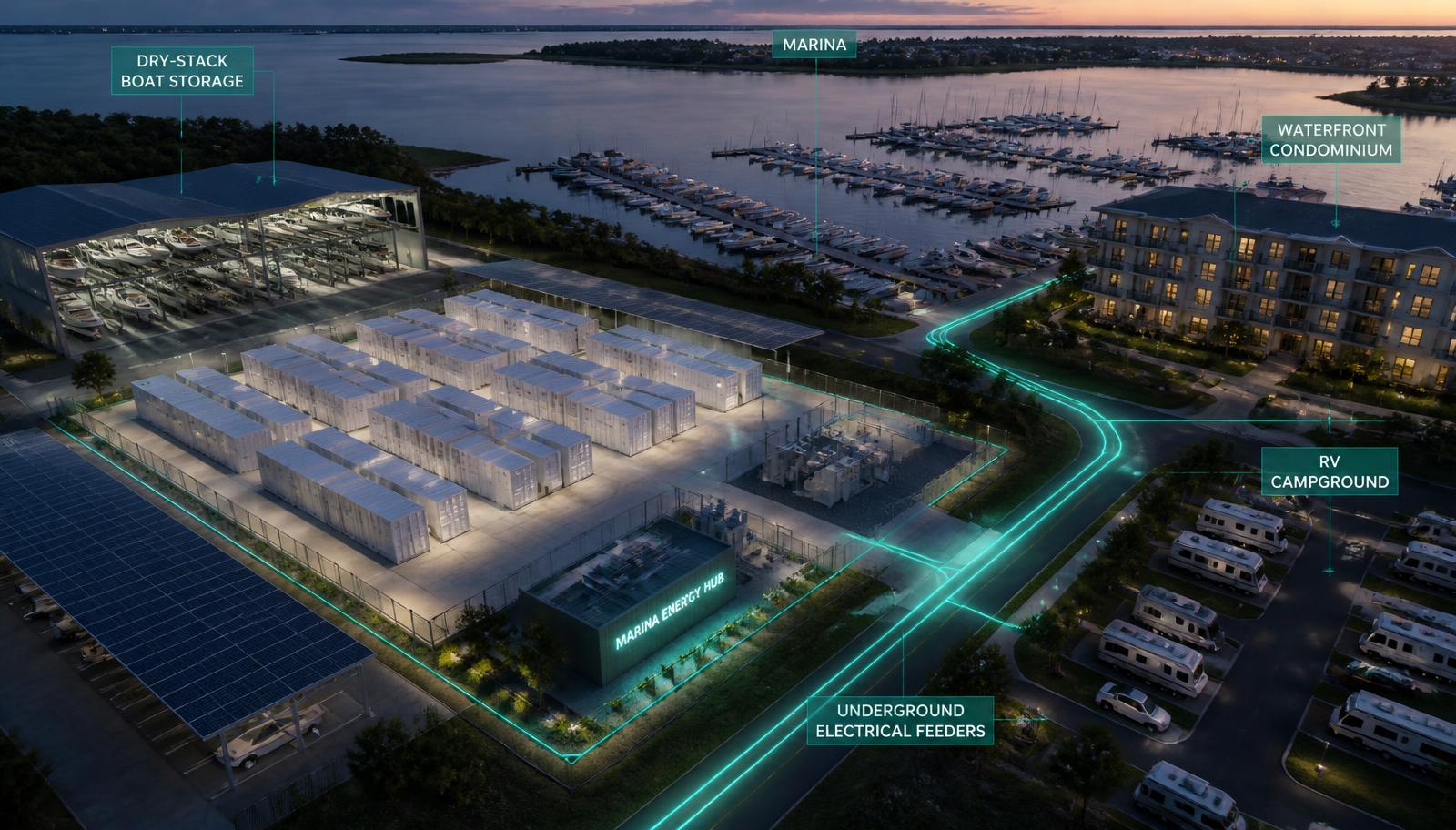
Site plan — aerial
Hub campus and its four spokes
Reference cluster: battery blocks and transformer yard on the anchor pad, with underground feeders reaching the marina, dry stack, campground and condominium.
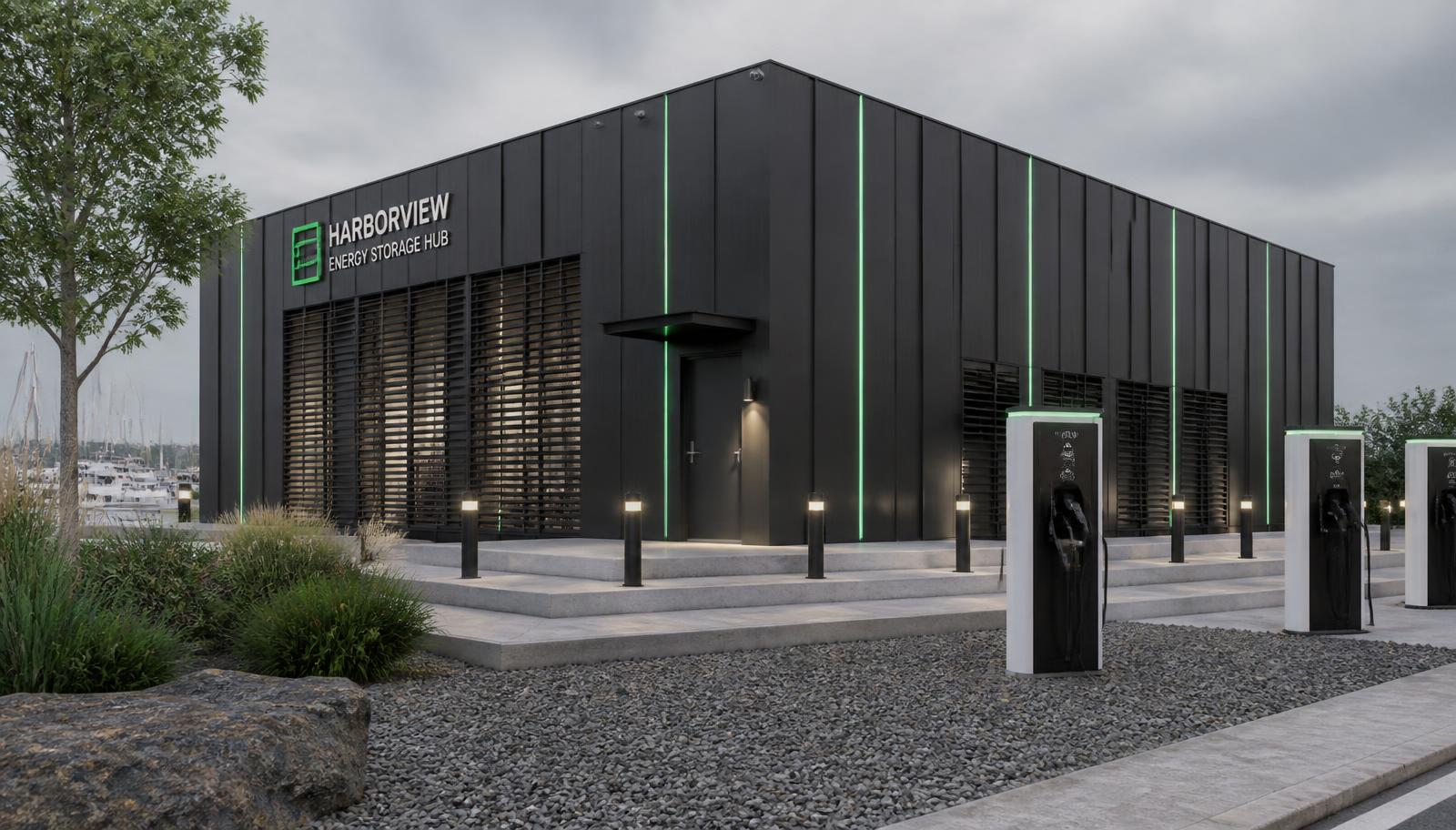
Exterior
Hub enclosure at grade
Louvered ventilation walls, flood-conscious plinth and a bidirectional pedestal apron sized for service access.
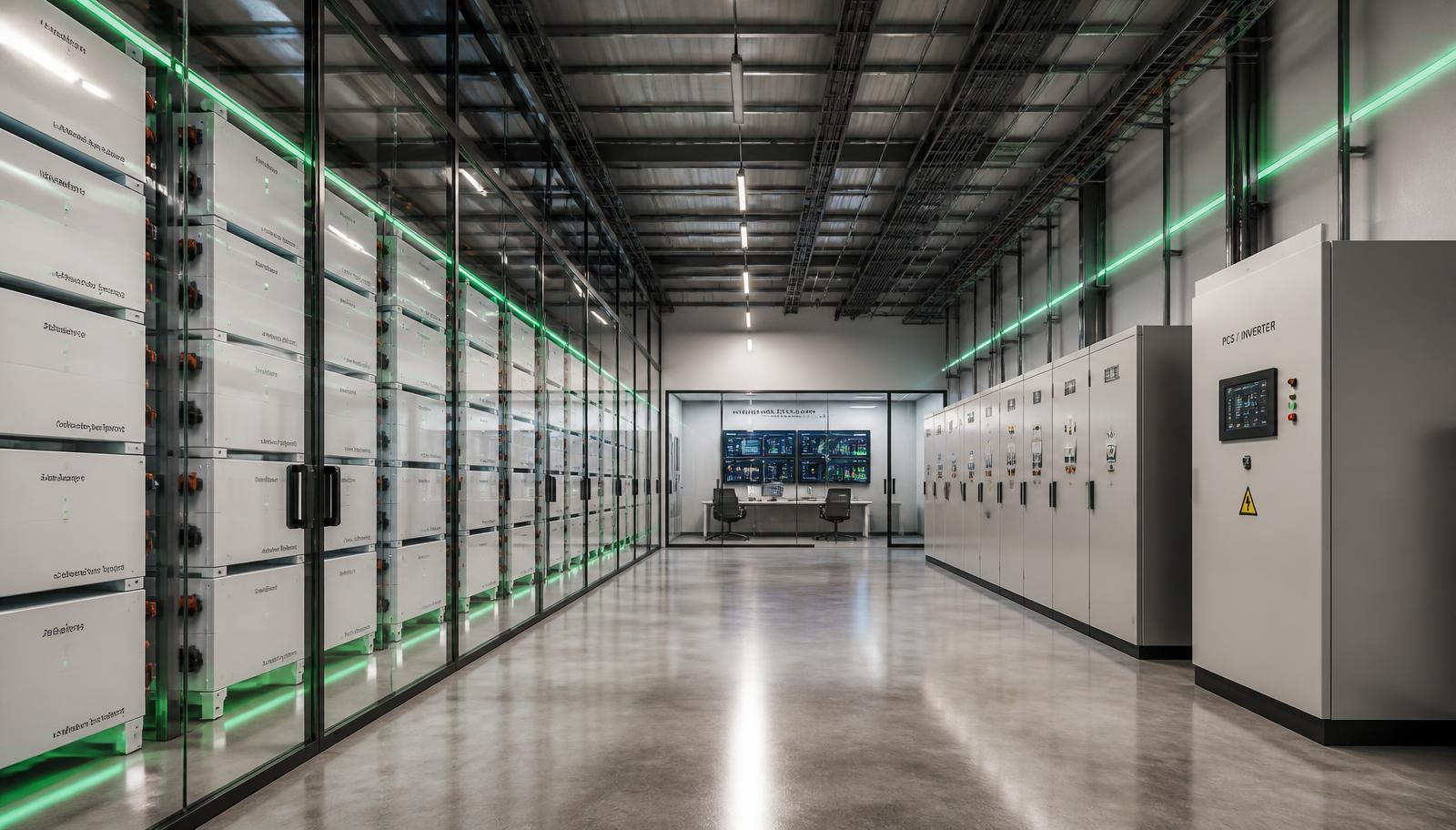
Interior — hub
Battery hall and PCS lineup
Racks behind a fire-rated glazed line, inverter and switchgear on the opposite wall, operations room on axis at the end of the aisle.
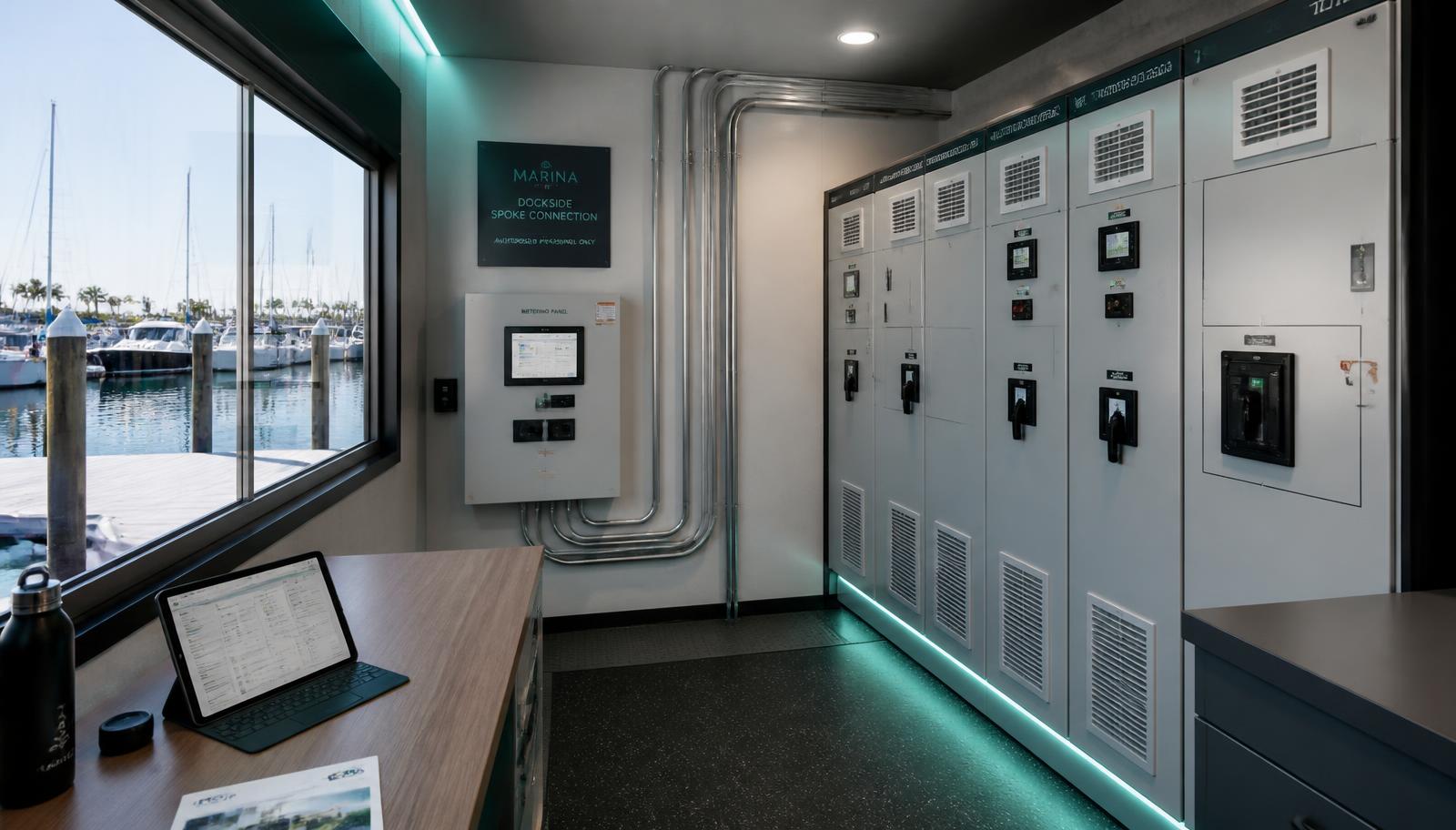
Interior — spoke
Dockside spoke connection room
Where a marina spoke lands: metering, protection and bidirectional feeder switchgear within sight of the slips it serves.
The five phases
- Phase 1
Origination
Site selection, feasibility and underwriting
- Phase 2
Agreements
Host license, spoke enrollment, interconnection filing
- Phase 3
Permitting
Building, fire, floodplain and design review
- Phase 4
Build
Hub construction and phased spoke buildout
- Phase 5
Energization
Commissioning, PTO and grid asset registration
Step by step
Step 1 · Phase 1 — Origination · Early weeks
Site selection and hub siting
We screen a candidate cluster for one anchor site that can host the hub, then map the spoke properties that sit inside its electrical and contractual reach.
- Load and interval-data review for the anchor property and each candidate spoke
- Flood elevation, setback, fire access and salt-exposure screen on the hub pad
- Distance-to-substation and feeder headroom check against the utility's hosting map
- Spoke inventory: slips, racks, pedestals, pads and units within the cluster radius
Deliverable: Cluster map with one ranked hub site and a prioritized spoke list.
Step 2 · Phase 1 — Origination · Early weeks
Feasibility and revenue model
Every hub is underwritten before a single agreement is signed. The model has to clear our yield floor on the anchor block alone, with spoke aggregation treated as upside.
- Tariff and demand-charge analysis for the host utility territory
- Wholesale market and program eligibility check for capacity, ancillary and demand response
- Enrollment forecast by spoke type — vessels, rigs, tow vehicles and resident EVs
- Capex build-up against the standard reference design
Deliverable: Signed-off pro forma with unlevered yield, payback and enrollment assumptions.
Step 3 · Phase 2 — Agreements · Mid-schedule
Host agreements and spoke enrollment
One site agreement for the hub host, one revenue-share form for each spoke. Both are standard documents; deviation requires executive approval so the portfolio stays financeable.
- Hub site agreement: pad, easement, service access and term
- Spoke revenue-share agreements matched to each property's slip, rack, pad or unit inventory
- Owner-group and HOA approvals for condo and multi-property clusters
- Participant terms for vessel and rig owners who enroll their batteries
Deliverable: Executed hub agreement plus spoke agreements covering the target cluster.
Step 4 · Phase 2 — Agreements · Longest lead item
Interconnection application
Usually the long pole. We file the hub against the utility's storage interconnection process using the study package built for that territory — later hubs in the same territory reuse most of it.
- Pre-application report and feeder capacity confirmation
- System impact and facilities study submission with the standard one-line
- Export control, anti-islanding and protection settings agreed with the utility
- Interconnection agreement negotiation and deposit
Deliverable: Executed interconnection agreement with an approved export limit.
Step 5 · Phase 3 — Permitting · Runs in parallel
Permitting and local approvals
Runs alongside interconnection. The enclosure family is pre-engineered, so the review is about siting and life safety rather than product approval.
- Building, electrical and fire permits with the pre-approved enclosure package
- Coastal, floodplain and shoreline reviews where the hub sits on a waterfront parcel
- Fire-department review of battery spacing, suppression and access lanes
- Design review for the clapboard or cedar-shingle enclosure treatment
Deliverable: Issued permits and an accepted life-safety plan on file.
Step 6 · Phase 4 — Build · Build window
Hub construction and block delivery
Civil work, then the containerized prefabricated battery blocks arrive as a set. The hub is built to accept the next increment without re-opening the pad or the interconnection.
- Pad, piers and flood-elevation structure; conduit and duct bank to the service
- Container placement, enclosure cladding and roof assembly
- Medium-voltage switchgear, transformer and protection relays
- Provisions and spare positions for the next increment
Deliverable: Mechanically complete hub with its first block installed.
Step 7 · Phase 4 — Build · Phased rollout
Spoke buildout and submetering
Spokes come online row by row and dock by dock, so revenue from the first section helps fund the next. Every connection is submetered from day one.
- Slip feeders, rack pedestals, campground pedestal upgrades and condo dock runs
- Bidirectional pedestal commissioning and per-connection submetering
- Site controller and comms backhaul to the hub EMS
- Host staff training on enrollment, billing and seasonal operation
Deliverable: Live, metered spokes reporting into the hub energy management system.
Step 8 · Phase 5 — Energization · Pre-energization
Commissioning and witness testing
The utility witnesses the protection scheme and dispatch behavior. This is where the measurement standard starts producing the numbers a buyer will diligence later.
- Protection, anti-islanding and export-limit verification with the utility present
- Round-trip efficiency, ramp rate and dispatch-response baselining
- Islanding and outage-support test with the host's critical loads
- Permission to operate issued against the commissioning checklist
Deliverable: Permission to operate and a signed commissioning record.
Step 9 · Phase 5 — Energization · Final phase
Grid asset registration and market enrollment
The hub stops being equipment and becomes a registered, revenue-earning grid asset — with the aggregated spoke capacity registered behind it as a single dispatchable resource.
- ISO/RTO or utility program registration with resource ID and telemetry mapping
- Aggregation registration for enrolled vessel and rig batteries behind the hub
- Telemetry, settlement metering and market-operator connectivity testing
- First dispatch, settlement reconciliation and quarterly performance reporting begins
Deliverable: Registered grid asset earning capacity, energy and ancillary revenue.
What gets built
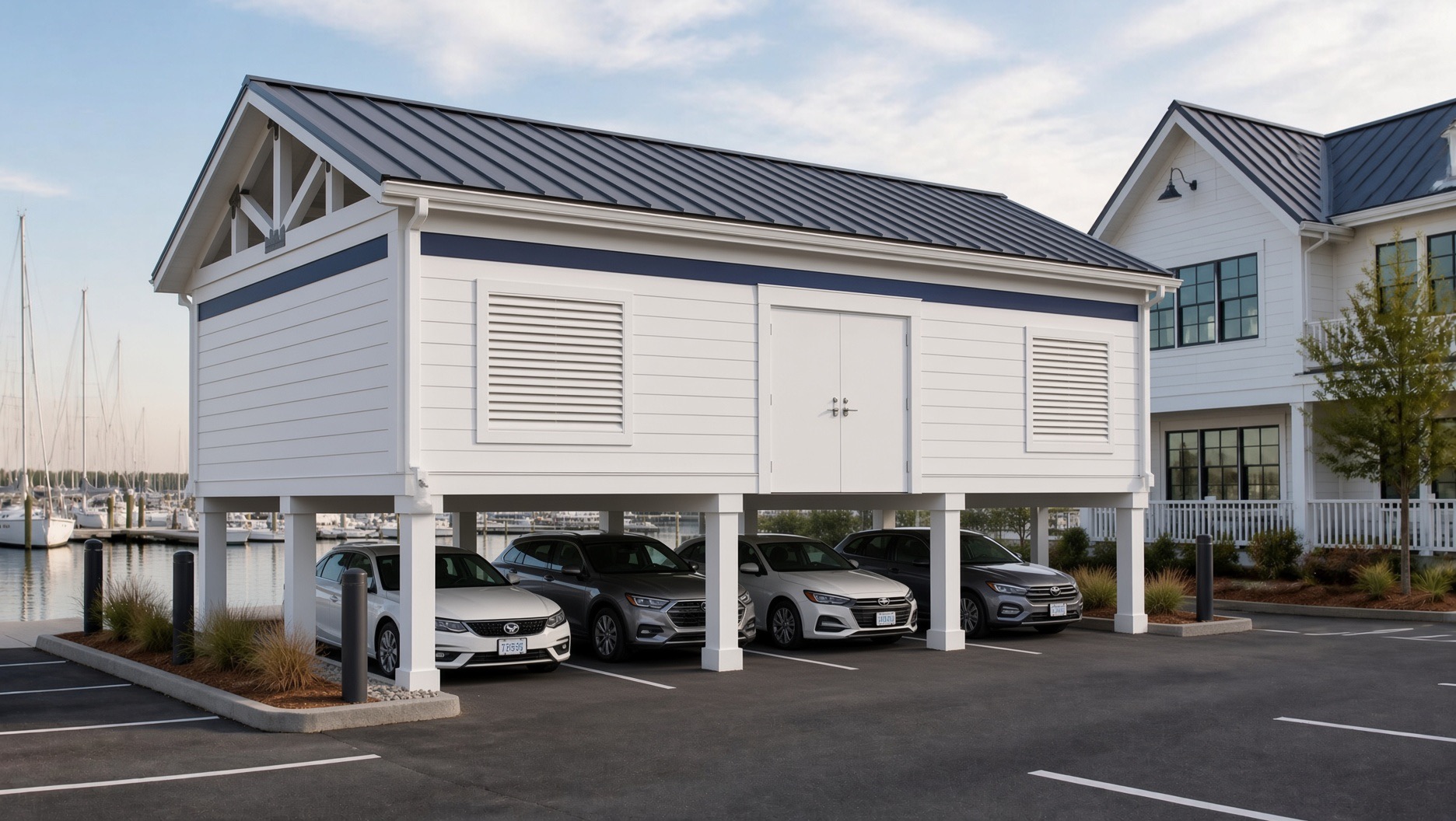
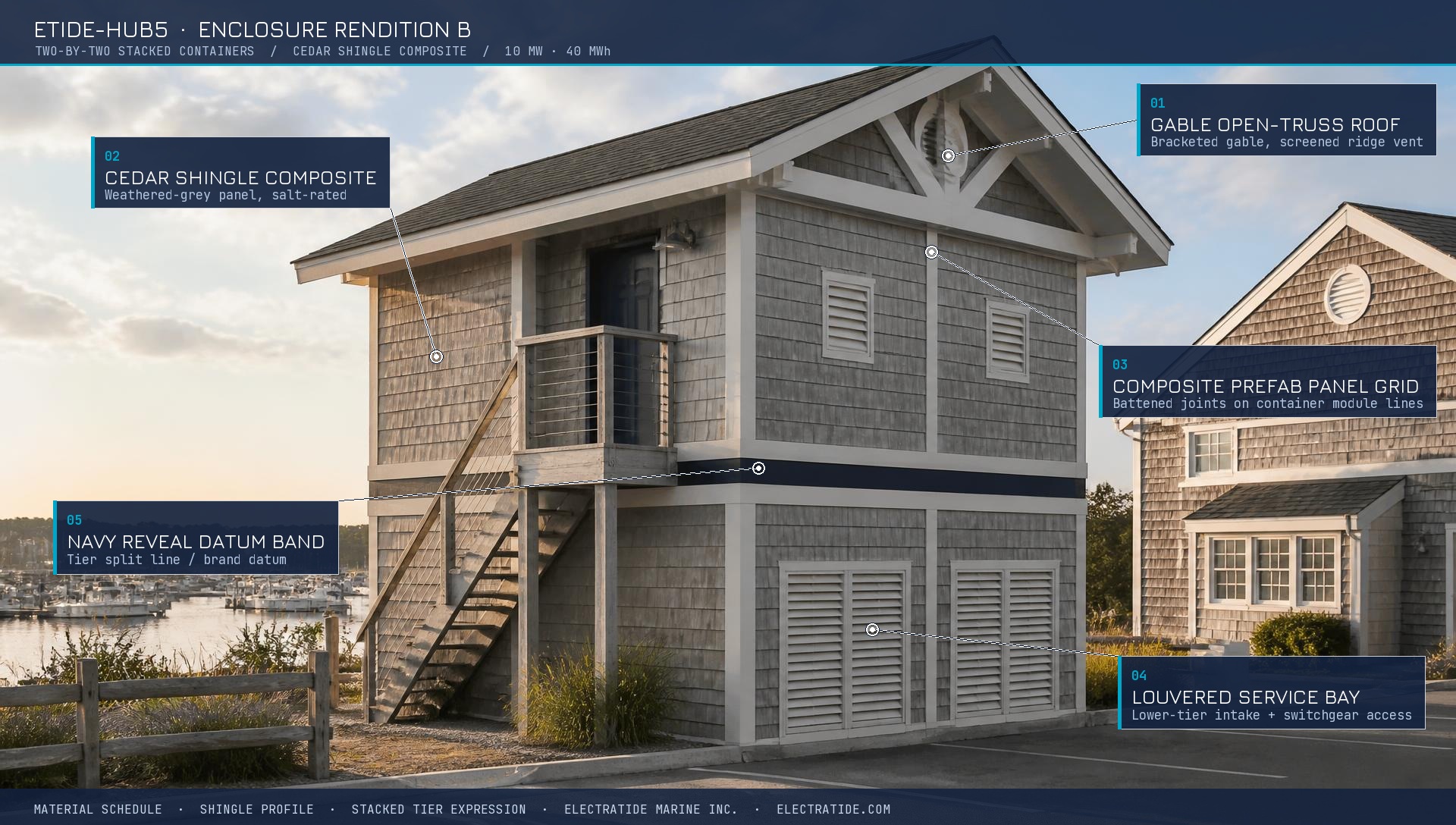
The enclosures are pre-engineered and repeat from site to site. Every project also includes fast charging as a service — bidirectional fast-charge service pedestals installed with the hub, so slips, sites and docks can charge and sell back on the same hardware. Pedestal count, siting and charge rate are engineered for your property and released with your tailored plan after your assessment request, under confidentiality. The dimensioned schematic — block sizing, feeder counts and interconnection voltage for your property — is released with the same plan.
Deployment and sizing specification
Block capacity and geometry, hub and spoke layout, feeder design, interconnection voltage and the phased build-out schedule for your site.
- Block capacity and geometry for your site
- Number of fast-charge pedestals included at your property
- Siting and circuit layout — which docks, loops, racks or bays they land on
- Charge rate per pedestal and total installed fast-charge capacity
- Hub and spoke feeder layout
- Interconnection voltage and one-line diagram
- Phased build-out schedule
Permitting & acceptance
Three approvals, in plain language
Nothing here is exotic — it is the same three doors every grid-connected battery walks through. What varies is who sits behind each door in your state, and how early you knock.
Your electric utility
Utility interconnection
Permission to connect a battery to the grid and, separately, permission to push power back onto it. The utility studies whether your feeder can absorb the block without hurting voltage or protection, then sets an export limit and the settings our inverters must obey.
- A one-line diagram and equipment sheets for the block
- A system impact study, and a facilities study if upgrades are needed
- Agreed protection settings, anti-islanding and export cap
- A signed interconnection agreement before construction closes out
Typical clock: 4–9 months first time in a territory, far shorter on repeat blocks
Your city or county
Local building and fire approval
The same permits any large electrical addition needs, plus a fire review specific to batteries: how far the enclosure sits from occupied buildings and property lines, how it is ventilated, and how a crew reaches it. Waterfront parcels add flood elevation and shoreline review.
- Building, electrical and, where applicable, mechanical permits
- Fire-department review of spacing, suppression and access lanes
- Floodplain or coastal review when the pad is near the water
- Design or architectural review in districts with appearance standards
Typical clock: 2–5 months, run in parallel with interconnection
Your state
State rules and market acceptance
The state sets the interconnection rulebook the utility follows, the code edition your fire marshal enforces, and whether stored energy can earn money through a market or only through utility programs. It also decides which incentives you can stack.
- The state commission's interconnection rule and the tariff you file under
- Adopted fire and electrical code editions covering energy storage
- ISO/RTO participation model, or the utility program that stands in for one
- State storage incentives, and any prevailing-wage or siting conditions attached
Typical clock: No separate queue — it shapes the other two tracks
State specifics — the exact interconnection rule, ISO/RTO footprint, and shoreline or floodplain reviews that apply to your address — are generated in your tailored plan after the eligibility quiz.
Frequently asked
Do I need my own permits as the host property?
GridLynQ files and carries the permits and the interconnection application for the hub. You sign as the property owner where the jurisdiction requires it, and you keep a copy of every approval in the site file.
Will this force a service upgrade on my property?
The hub gets its own service and interconnection, so it does not ride on your existing panel. Spoke work — slip feeders, pedestals, rack rows — is sized to your existing service wherever staged charging allows, and we tell you up front in the assessment if a feeder or panel has to grow.
What is the difference between interconnection and permission to operate?
The interconnection agreement is the contract that says you may connect. Permission to operate is the utility's sign-off after witness testing that you may actually run. Between them sit construction and commissioning.
Why does the first hub in a state take longer than the next one?
The first project produces the study package, the protection settings, the fire-review record and the permit set for that territory. Every later block in the same territory reuses that work, which is the entire point of the standard reference design.
What usually slows a project down?
In order: utility study queues, floodplain or shoreline review on waterfront pads, and fire-department questions about battery spacing on tight sites. All three are addressed earlier now — flood elevation and access are screened during site selection, before any agreement is signed.
Do vessel and rig owners need approvals to enroll?
No. Owners sign a participant agreement covering when their battery can be dispatched and the floor state of charge we never go below. The grid-facing registration sits with the hub, not with individual boats or rigs.
Can the hub keep my property running in an outage?
Islanding for defined critical loads is designed in and proven during commissioning. Scope depends on what your electrician can separate onto a backed-up panel — typically fire panels, lighting, door operators, pumps and a shop bay rather than the whole property.
What happens at the end of the term?
Removal and site-restoration obligations are written into the site agreement, so the property is never left with stranded equipment. End-of-term, buyout and equipment-refresh provisions are walked through with you directly at agreement stage, under confidentiality.
Nonprofit partnership
Where the Harbor Current Foundation dovetails
Public dollars for waterfront resilience are usually written for a community benefit, not a commercial asset. The Harbor Current Foundation is the partner side of a GridLynQ cluster: it carries the public-benefit case, assembles the grant package, and lets a host property pursue funding it could not apply for alone.
Who they are — harborcurrent.org
Educate. Advocate. Transform.
Harbor Current Foundation advances clean water transportation to protect waterways, improve public health, and keep access to the water sustainable for the next generation. Its core initiatives — harbor electrification, vessel conversion, sustainable infrastructure, community partnerships, and education and advocacy — line up directly with a GridLynQ hub: dockside charging and clean power at the harbor, with the community and workforce story documented alongside it. The foundation works with Electratide Marine Inc. on the technology side and runs a voluntary public-private model rather than a mandate-driven one.
85%
Of vessels electric by 2040
4
Pilot harbors launching clean transit
20–30
Green jobs created per pilot city
5,000+
Residents reached through education
Their sequence is Pilot → Prove → Scale: start at one harbor, verify the results publicly, then help the next harbor replicate it. That is the same order a hub-and-spoke cluster is built in, which is why a foundation-backed pilot site and a GridLynQ anchor hub are usually the same project.
Grant writing and application management
The foundation builds the narrative, budget, match documentation and letters of support, then manages deadlines and post-award reporting. Host properties get access to funding programs written for nonprofits and public benefit rather than for private infrastructure.
Community resilience case
Grant reviewers fund outcomes, not equipment. The foundation frames the hub as a resilience asset — backup power for harbor operations, fuel docks, pump-out, life-safety systems and cooling or warming space during outages — and documents who benefits.
Measurement and public reporting
Awards come with reporting duties. The foundation carries the measurement plan — availability, dispatch, avoided emissions, outage hours covered — using the same verified performance data the commercial side publishes quarterly.
Cluster and coalition convening
Many programs score regional applications higher than single sites. The foundation convenes harbor commissions, campground associations, condo boards and municipalities into one applicant coalition, which also happens to be the ideal hub-and-spoke footprint.
Funding lanes we write toward
Program availability, deadlines and match requirements change every cycle — we confirm current terms before any application is built.
Energy storage and grid resilience programs
Federal
Fund the resilience share of a hub where it backs critical waterfront and community loads.
Rural energy and small-business programs
Federal
Fit rural campgrounds, RV parks and inland marinas that qualify as rural small businesses.
Coastal and port resilience funds
Federal / state
Support flood-elevated siting, shoreline hardening and harbor continuity of operations.
State clean energy and storage incentives
State
Upfront and performance-based payments that improve the yield on the first blocks in a territory.
Utility program and pilot funding
Utility
Cover interconnection study and equipment costs in exchange for dispatch participation.
Workforce and marine trades training
State / philanthropic
Train local electricians and yard staff on bidirectional systems, staffing the buildout locally.
Start a cluster in your area
Tell us the anchor property and the marinas, yards or campgrounds around it. We come back with a hub siting, a phased spoke sequence and the schedule to registration.
Get started
Find out what V2G is worth at your property
Marinas, boat yards, and campgrounds: take the 2-minute eligibility quiz and get a tailored V2G plan with equipment, revenue, and interconnection steps.
No GridLynQ block is energized yet. Every figure shown is a modelled profile of a candidate site's conditions — speculative, not measured, and not a quote or a guarantee of results.