Boat storage facilities

Dry stack, indoor racks and trailer yards that earn while boats sit still.

Storage is the longest, most predictable dwell time in the marine industry. GridLynQ makes each rack, bay and trailer row a submetered, bidirectional connection — so charging becomes a billable add-on and parked batteries become a dispatchable asset.

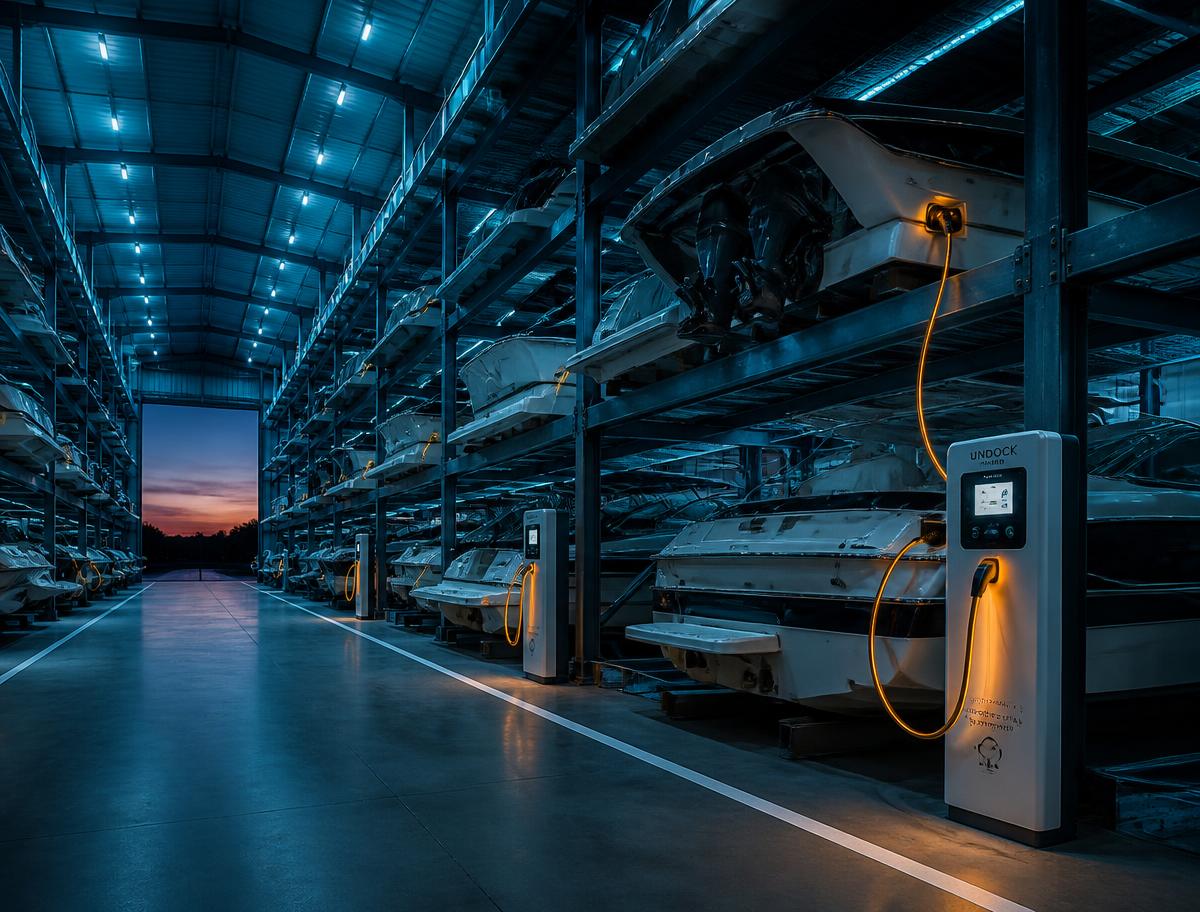
Indoor dry stack boat storage warehouse with charging pedestals plugged into racked boats

New revenue

A new revenue line from bay capacity you already have

20–30%

Share of stored vessels that realistically stay plugged and dispatchable

0 CapEx

Revenue-share deployments available for qualifying facilities

Example use cases

Three storage formats, three ways to earn.

Dry stack

Dry stack racks

High-density racked hulls sit motionless for months at a time — the most predictable dispatch window in marine storage. Rack-level bidirectional pedestals let each tier charge, hold and export on schedule.

Facility profile

Typical size
120–400 racked hulls across 3–5 tiers
Dwell time
6–9 months per contract
Service upgrade
Usually none — staged dispatch fits existing capacity

What we install

  • Rack-level submetering so every bay bills to a storage contract instead of an absorbed cost
  • Sequenced charging that respects forklift launch schedules and keeps hulls launch-ready
  • Aggregated export from the racks that are staying put, dispatched during evening peaks
  • Thermal and state-of-charge alerts sized for enclosed, high-density lithium packs

A 300-hull dry stack typically converts 20–30% of racked vessels into a dispatchable block without touching the service entrance.

Indoor & covered

Indoor storage buildings

Conditioned and covered buildings already carry lighting, ventilation and fire panels on one meter. V2G turns the same service into a demand-charge hedge and a backup source for life-safety loads.

Facility profile

Typical size
40–150 enclosed bays plus a shop bay
Dwell time
Full winter term, often 8+ months
Service upgrade
Panel work in about a third of buildings

What we install

  • Building-level load management that shaves the demand peak set by ventilation and shop equipment
  • Maintenance charging that keeps house banks healthy through long indoor storage terms
  • Islanding for fire panels, lighting and door operators when the utility drops
  • Remote monitoring so a single manager covers multiple buildings without walking bays

Indoor operators most often see the fastest payback from demand-charge reduction, before any grid revenue is counted.

Trailer yards

Outdoor trailer & yard storage

Gravel and paved yards are the cheapest square footage to electrify. Pedestal runs down each row give trailered boats, tow vehicles and yard equipment a metered, bidirectional connection.

Facility profile

Typical size
80–500 trailer spaces on gravel or paved rows
Dwell time
Seasonal, with steady long-term rows
Service upgrade
New yard feeder and pedestal rows in most cases

What we install

  • Row-by-row pedestal deployment, phased so revenue funds the next section
  • Metered charging as a paid yard add-on for trailered boats and electric tow vehicles
  • Weather-rated enclosures and ground-fault protection built for outdoor, unattended rows
  • Solar canopy and battery pairing where the existing yard service is thin

Yards typically start with two rows nearest the service, then expand as the metered charging line item proves itself.

Ready to price your racks and rows?

Tell us your storage format, unit count and service size. We come back with a phased buildout and the revenue each section can carry.

Get a V2G assessment for your site

Marinas, boat yards and campgrounds: tell us where you are and what you run. We map storage-slip capacity, pedestal upgrades and grid revenue for your specific site type.

Get started

Find out what V2G is worth at your property

Marinas, boat yards, and campgrounds: take the 2-minute eligibility quiz and get a tailored V2G plan with equipment, revenue, and interconnection steps.

No GridLynQ block is energized yet. Every figure shown is a modelled profile of a candidate site's conditions — speculative, not measured, and not a quote or a guarantee of results.

No GridLynQ block is energized yet. Every figure shown is a modelled profile of a candidate site's conditions — speculative, not measured, and not a quote or a guarantee of results.