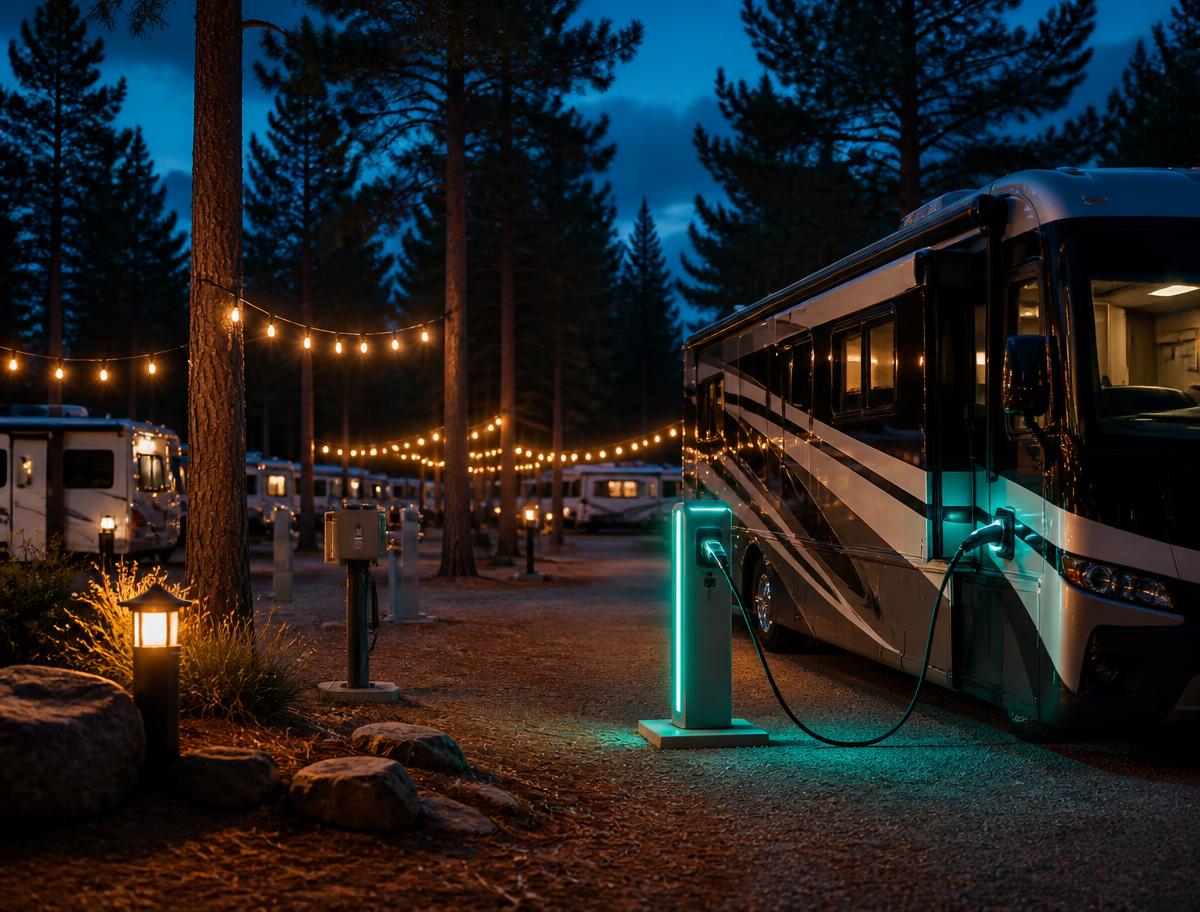
Seasonal rigs stay connected for months and transient guests arrive expecting real charging. One GridLynQ build serves both: metered power for every stay, and dispatchable capacity from the rigs that never leave.
A new revenue line from pedestal capacity you already have
30–50%
Share of seasonal rigs that realistically stay plugged and dispatchable
0 CapEx
Revenue-share deployments available for qualifying parks
Where it fits
Seasonal loops, transient loops and full resorts.
Seasonal loops
Full-time and seasonal sites
Seasonal residents keep rigs connected month after month. Those batteries are the most predictable, enrollable capacity a campground owns.
Park profile
Typical size
60–300 seasonal sites on 30A/50A pedestals
Dwell time
Full season, many sites year-round
Service upgrade
Loop-level load management before new feeders
What we install
50A pedestal retrofits with V2G-ready bidirectional units on long-term loops
Per-site submetering so electricity stops being buried in the seasonal rate
Load management that protects your service as more rigs electrify
Enrollment in utility demand-response for the sites that stay put
Seasonal loops are usually phase one — the same rigs are connected long enough to make dispatch predictable.
Transient loops
Transient and overnight loops
Guests arrive in EV tow vehicles expecting real charging. Metered pedestals turn arrival peaks into billable revenue instead of an unrecovered cost.
Park profile
Typical size
40–200 transient sites with high arrival churn
Dwell time
1–7 nights, concentrated 3–8pm arrivals
Service upgrade
Managed charging usually avoids a service upgrade
What we install
Managed charging that flattens the evening arrival peak automatically
Reservation-linked billing so charging appears on the stay folio
Tow-vehicle and RV charging posts sized for mixed 30A/50A inventory
Availability data you can advertise to EV-towing guests at booking time
Transient loops most often justify themselves on metered charging revenue and booking advantage alone.
Resorts & parks
RV resorts, cabin parks and public campgrounds
Resorts with cabins, pools, laundry and offices set a real demand peak. A GridLynQ hub trims that peak and keeps critical systems alive during outages.
Park profile
Typical size
Mixed cabins plus 100–400 RV sites and amenity buildings
Dwell time
Season-long, with year-round amenity load
Service upgrade
Scoped alongside amenity and loop expansion plans
What we install
Demand-charge shaving against pool pumps, laundry, offices and cabin load
Outage support for water systems, bathhouses, gates and reservation systems
Phased loop-by-loop deployment so revenue funds the next section
Owner reporting on metered revenue, demand savings and resilience hours
Resorts typically pair one loop of bidirectional pedestals with amenity-side demand savings in the first phase.
Segment brief
Take the park brief to your ownership group
One page covering how storage adds charging capacity without a service upgrade, how transient and seasonal sites are billed, and what a site assessment covers. Requested materials are reviewed by our team and sent under confidentiality.
Campground & RV park one-pager
Segment one-pagers, planning board packet, avoided-cost analysis and the presentation materials we bring to a board or council decision.
Per-site metering and guest billing model
Storage sizing that avoids a utility service upgrade
Off-season phasing so occupancy is never interrupted
You provide the site. We fund, build, own and stand behind the system.
GridLynQ does not sell equipment and walk away. We finance and install the system on the ground we energize, we operate it, and we carry full responsibility for battery performance and replacement. Agreement structure and commercial terms are walked through privately during your site assessment.
We fund and build it
GridLynQ pays for the equipment, the interconnection and the electrical work. There is no capital ask, no borrowing and no line item in your budget.
You earn from day one
The footprint we energize earns for the property from the moment the system is live, alongside a modernized electrical service you did not have to pay to build.
Performance is our obligation
GridLynQ stands behind battery performance against contracted capacity and availability targets. If a block underperforms, we make it right — not the host.
Replacement is our cost
Every cell, inverter and control system is ours to monitor, maintain and replace at end of life. Zero capital calls, zero disposal liability for the host.
Battery performance, safety monitoring, warranty administration and end-of-life replacement and recycling sit with GridLynQ. Agreement length, renewal structure and the rest of the commercial terms are reviewed with you directly, under confidentiality.
We share the revenue — and reward you for growing battery capacity
GridLynQ funds, owns and maintains the equipment; the host earns from day one with no capital outlay. GridLynQ participates with the campground on grid revenue under a long-term host site agreement, and a portion of the upside from growing enrolled capacity flows back to your site customers.
You share in the grid revenue
As the host, you earn an ongoing share of the grid revenue the site produces — set out in your host agreement, not left to a forecast.
Growth is rewarded
The more enrolled battery capacity your own customers bring onto the property, the more the site — and you — earn.
Your customers see the benefit too
Hosts pass a meaningful portion of that upside back to boaters or guests, so growth pays them as well.
Aligned and auditable
Enrolled capacity and grid revenue are metered and reconciled, so what you're owed is always verifiable.
See the share rate, growth steps and discount pool
The share rate, growth thresholds and pass-through terms are set out in the host agreement. We walk campground owners through the full model — with your numbers in it — after your request is reviewed, under confidentiality.
Share rate schedule and the capacity thresholds that step it up
Pass-through mechanics that benefit your site customers
Full-term host cashflow modelled on your property
Park assessment
Price your loops.
Send your site count, pedestal mix and season length. We come back with a phased upgrade plan and the revenue each loop can carry.
See your park's numbers
Send your site count, pedestal mix and season length below and we model your park's specific economics — the figures are released after review, under confidentiality.
Modelled grid revenue and demand savings for your site count and season
Payback and sensitivity ranges specific to your park
Fast charging as a service
Every project includes fast charging as a service, with bidirectional fast-charge service pedestals installed as part of the project — fast-charge rated and bidirectional, and sited on your highest-dwell docks, loops or bays. The pedestals are the revenue-facing edge of the site: your guests plug in, and the same hardware sells energy retail and sends it back for grid services.
• Installed, commissioned and maintained as part of the project — no host capex.
• Bidirectional, so charging revenue and grid revenue share one asset.
• Submetered per port, so charging income is reconciled with your statement.
Released with your tailored plan
• Number of fast-charge pedestals included at your property
• Siting and circuit layout — which docks, loops, racks or bays they land on
• Charge rate per pedestal and total installed fast-charge capacity
Pedestal count, siting and charge rate are engineered for your property and released with your tailored plan after your assessment request, under confidentiality.
Fast charging FAQ
What the fast-charging offer covers
The service pedestals are the part of the hub RV and EV guests actually touch. Here is how they are installed, paid for and maintained.
What is fast charging as a service?
Every project includes fast charging as a service, with bidirectional fast-charge service pedestals installed as part of the project — fast-charge rated and bidirectional, and sited on your highest-dwell docks, loops or bays. We own, install, commission and maintain the hardware, and RV and EV guests plug straight into it.
What does it cost me to install?
Nothing. The pedestals are installed as part of the project under the host lease — no host capex, no financing to arrange, and no equipment for your park crew to own or replace.
How do the pedestals make money for the site?
The same hardware works two ways: it sells energy retail to the vehicle or vessel plugged in, and it sends stored energy back for grid services. Both streams run through the host agreement, so charging income is not a separate deal to negotiate.
How is charging usage measured and reconciled?
Each port is submetered. Sessions are recorded per port and reconciled on your statement, so you can see exactly what was delivered, what was returned to the grid, and what it earned.
Are the pedestals bidirectional?
Yes. They are bidirectional by design, which is what lets a vehicle or vessel battery act as a grid resource while it sits parked or berthed instead of just drawing power.
Who maintains and services them?
We do, through certified electrician partners in your region. Servicing, firmware, parts and replacement over the life of the lease sit with us, not with the host.
How many pedestals go on my park, and where?
Pedestal count, siting and charge rate are engineered for your property, not quoted off a list. Pedestal count, siting and charge rate are engineered for your property and released with your tailored plan after your assessment request, under confidentiality.
Will they disrupt operations during install?
Trenching, conduit and foundations are staged around your season. We sequence the work with your park manager so RV and EV guests keep their access while the pedestals go in.
Permitting & interconnection timeline
Answer six questions and we will lay out the phased schedule — utility study, permits, procurement, construction and permission to operate — for your site.
65 wks
Kickoff to permission to operate (~15.0 months)
35 wks
Kickoff to construction start
National baseline
Full study path: feasibility plus system-impact study
Phase 1 — Site data & feasibility
Weeks 0–4 · GridLynQ + property team · critical path
Collect 12 months of interval data and utility bills for every meter.
Field verification: service size, main switchgear, transformer and pad locations.
Produce the existing single-line and marked-up site plan (none on file today).
Confirm site control documentation for the utility and incentive programs.
Factory-witnessed functional test of protection settings and export limits.
Utility witness test and permission to operate (PTO).
Market / program enrollment and dispatch telemetry verification.
Operator training and handover of the O&M runbook.
Schedule drivers
No pre-application report yet — ordering it now de-risks the study scope by several weeks.
Missing as-built drawings and interval data are the most common cause of a stalled Phase 1.
Add your city and state for the exact tariff, grid operator and environmental review path.
Planning estimate only. GridLynQ confirms every date against the serving utility's tariff clock and the local AHJ during the assessment.
Get started
Find out what V2G is worth at your property
Marinas, boat yards, and campgrounds: take the 2-minute eligibility quiz and get a tailored V2G plan with equipment, revenue, and interconnection steps.
No GridLynQ block is energized yet. Every figure shown is a modelled profile of a candidate site's conditions — speculative, not measured, and not a quote or a guarantee of results.
No GridLynQ block is energized yet. Every figure shown is a modelled profile of a candidate site's conditions — speculative, not measured, and not a quote or a guarantee of results.