01
Your energy cost stops climbing
A fixed, contractually capped rate for the power your marina consumes under a long-term agreement — instead of a utility tariff that has risen every year and will keep rising.
Marinas & boat yards
GridLynQ funds, builds, owns and operates a bidirectional energy hub on your property. You lock in what power costs you for the term, get the dock upgrade electric boating is about to demand, and earn on every kilowatt-hour the hub moves — with a tax abatement case we help you take to the town.
The offer in four lines
A fixed, contractually capped rate for the power your marina consumes under a long-term agreement — instead of a utility tariff that has risen every year and will keep rising.
Feeder and pedestal upgrades come with the build. When electric and hybrid boats arrive in volume, your docks already carry them — funded by us, not by a capital project you carry.
A bidirectional hub built from prefabricated battery blocks, earning grid, capacity and charging revenue — and you share in it, from a contractual floor, not a forecast.
Demand-charge and energy savings on your own bill, and a documented resilience and tax-base case we help you take to the town for abatement on the upgrade.
New revenue
A new revenue line from dock capacity you already have
8–10 mo
Average slip occupancy with a vessel plugged in
0 CapEx
Revenue-share deployments available for qualifying harbors
Where it fits
Wet slips
Annual and seasonal berths hold electric and hybrid vessels for most of the year. Bidirectional pedestals let those house banks support the grid while the boat sits safe in its berth.
Most harbors start on one dock loop, prove the metering, then extend pedestal-by-pedestal as slips renew.
Boat yards
Haul-out season concentrates hulls, lifts and shop load on one meter. Metered power on the hardstand turns winter into your highest-value dispatch window.
Yards typically see demand-charge savings pay for the first phase before any grid revenue is counted.
Town & club harbors
Town harbors and clubs answer to boards and taxpayers. A GridLynQ hub adds resilience for harbor buildings and a defensible revenue line without a capital ask.
Public harbors usually lead with resilience and cost avoidance, with grid revenue as the second argument.
What the host gets
GridLynQ does not sell equipment and walk away. We finance and install the system on the ground we energize, we operate it, and we carry full responsibility for battery performance and replacement. Agreement structure and commercial terms are walked through privately during your site assessment.
GridLynQ pays for the equipment, the interconnection and the electrical work. There is no capital ask, no borrowing and no line item in your budget.
The footprint we energize earns for the property from the moment the system is live, alongside a modernized electrical service you did not have to pay to build.
GridLynQ stands behind battery performance against contracted capacity and availability targets. If a block underperforms, we make it right — not the host.
Every cell, inverter and control system is ours to monitor, maintain and replace at end of life. Zero capital calls, zero disposal liability for the host.
Battery performance, safety monitoring, warranty administration and end-of-life replacement and recycling sit with GridLynQ. Agreement length, renewal structure and the rest of the commercial terms are reviewed with you directly, under confidentiality.
If the relationship doesn’t work — your exit termsHost questions
Straight answers on locked energy cost, permitting timelines, interconnection readiness, and what the dock actually has to give up during construction.
Your slips are served under a fixed, contracted rate schedule for the term rather than the utility's escalating tariff. Onsite storage lets us buy and store energy off-peak and discharge during the expensive hours, so the price you charge boaters stops tracking every rate case. If the utility raises rates, that spread grows in your favor instead of eating your margin.
It covers the energy delivered through the GridLynQ-enabled pedestals and any storage-served load on the dock loop. Utility fixed customer charges, taxes, and load outside the enabled circuits stay on your existing bill. Every exclusion is written into the term sheet before you sign, not discovered later.
Typical harbors run 3–6 months from signed site plan to construction start: electrical and building permits in weeks, with the longer pole being shoreline, floodplain, or coastal-zone review where it applies. Your tailored plan lists the exact authorities for your address, and we file and carry the applications rather than handing you a checklist.
Most first phases are staged to fit the service you already have — enabled pedestals with managed charging, plus storage that shaves the peak instead of raising it. When a feeder, transformer, or panel does need to grow, we flag it in the assessment with the cost and the utility lead time up front, and the hub carries its own service so it does not ride on your panel.
Readiness means your one-line, meter configuration, and export limits satisfy the utility's rule for storage and bidirectional assets. Applications commonly land in the 4–9 month band from filing to permission to operate, depending on state and whether export is enrolled. We file the application, run the witness test, and keep you posted at each utility milestone.
Work is phased dock by dock and scheduled around your season — most harbors take the first loop in shoulder season. Slips come offline in small groups for days, not the whole marina for months, and the sequence is agreed in writing before mobilization.
Qualifying harbors deploy at zero CapEx under a revenue-share structure: GridLynQ funds the equipment and installation and shares the grid revenue and energy margin with you. If you would rather own the asset, we price a straight purchase or a hybrid, and both paths are modeled side by side in your plan.
The economics do not depend on it. Storage earns grid revenue and peak savings on day one from your existing load, and the pedestals serve today's conventional shore power. Bidirectional capability is headroom you already paid for once the fleet arrives, not the thing carrying the pro forma.
Often yes. Storage and resilience assets qualify for state incentives and, in many towns, negotiated abatements tied to the upgraded infrastructure and emergency backup value. Our municipal resilience materials are built for exactly that conversation with your assessor and council.
Configured for islanding, the storage block keeps critical dock loads — pumps, lifts, refrigeration, office, fuel — running through an outage. That is a service you can price for transient boaters and a talking point with your town during storm season.
Segment brief
One page covering how bidirectional slips work, where the revenue comes from, what a site assessment covers and what we need from you. Requested materials are reviewed by our team and sent under confidentiality.
Segment one-pagers, planning board packet, avoided-cost analysis and the presentation materials we bring to a board or council decision.
Dock assessment
Send your slip count, service size and season length. We come back with a phased pedestal plan and the revenue each dock can carry.
Send your slip count, pedestal mix and season length below and we model your dock's specific economics — the figures are released after review, under confidentiality.
Fast charging as a service
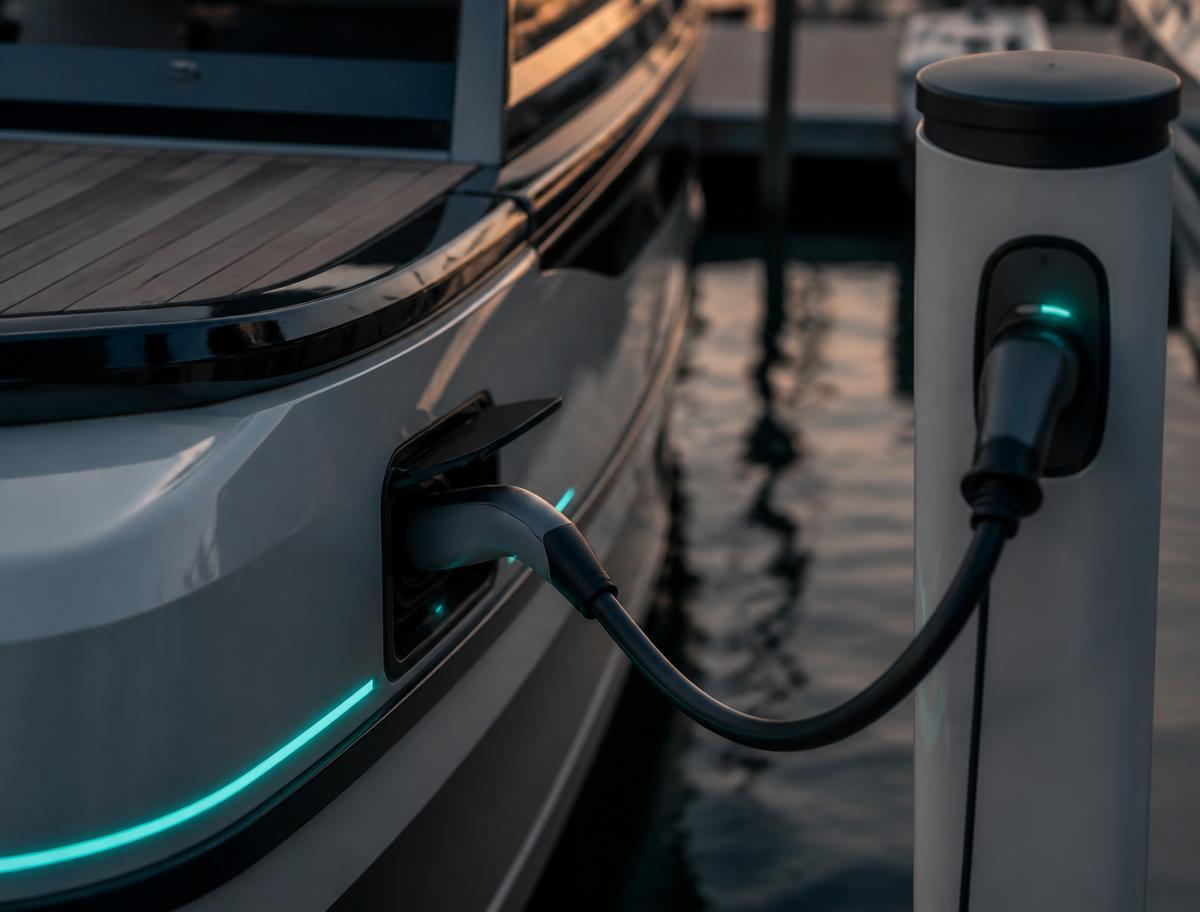
Every project includes fast charging as a service, with bidirectional fast-charge service pedestals installed as part of the project — fast-charge rated and bidirectional, and sited on your highest-dwell docks, loops or bays. The pedestals are the revenue-facing edge of the site: your guests plug in, and the same hardware sells energy retail and sends it back for grid services.
Released with your tailored plan
Pedestal count, siting and charge rate are engineered for your property and released with your tailored plan after your assessment request, under confidentiality.
Fast charging FAQ
The service pedestals are the part of the hub boaters and slip holders actually touch. Here is how they are installed, paid for and maintained.
Every project includes fast charging as a service, with bidirectional fast-charge service pedestals installed as part of the project — fast-charge rated and bidirectional, and sited on your highest-dwell docks, loops or bays. We own, install, commission and maintain the hardware, and boaters and slip holders plug straight into it.
Nothing. The pedestals are installed as part of the project under the host lease — no host capex, no financing to arrange, and no equipment for your dock crew to own or replace.
The same hardware works two ways: it sells energy retail to the vehicle or vessel plugged in, and it sends stored energy back for grid services. Both streams run through the host agreement, so charging income is not a separate deal to negotiate.
Each port is submetered. Sessions are recorded per port and reconciled on your statement, so you can see exactly what was delivered, what was returned to the grid, and what it earned.
Yes. They are bidirectional by design, which is what lets a vehicle or vessel battery act as a grid resource while it sits parked or berthed instead of just drawing power.
We do, through certified electrician partners in your region. Servicing, firmware, parts and replacement over the life of the lease sit with us, not with the host.
Pedestal count, siting and charge rate are engineered for your property, not quoted off a list. Pedestal count, siting and charge rate are engineered for your property and released with your tailored plan after your assessment request, under confidentiality.
Trenching, conduit and foundations are staged around your season. We sequence the work with your dock manager so boaters and slip holders keep their access while the pedestals go in.
Answer six questions and we will lay out the phased schedule — utility study, permits, procurement, construction and permission to operate — for your site.
69 wks
Kickoff to permission to operate (~15.9 months)
39 wks
Kickoff to construction start
National baseline
Full study path: feasibility plus system-impact study
Phase 1 — Site data & feasibility
Weeks 0–4 · GridLynQ + property team · critical path
Phase 2 — Utility pre-application & AHJ pre-submittal
Weeks 4–7 · GridLynQ interconnection lead · critical path
Phase 3 — Interconnection application & study
Weeks 7–21 · Utility + GridLynQ · critical path
Phase 4 — Permits & environmental review (parallel)
Weeks 7–25 · Electrical contractor of record + GridLynQ · critical path
Phase 5 — Long-lead procurement
Weeks 19–39 · GridLynQ supply chain · critical path
Phase 6 — Construction & installation
Weeks 39–62 · Electrical contractor of record · critical path
Phase 7 — Commissioning, witness test & PTO
Weeks 62–69 · Utility + GridLynQ commissioning · critical path
Schedule drivers
Planning estimate only. GridLynQ confirms every date against the serving utility's tariff clock and the local AHJ during the assessment.
Get started
Marinas, boat yards, and campgrounds: take the 2-minute eligibility quiz and get a tailored V2G plan with equipment, revenue, and interconnection steps.
No GridLynQ block is energized yet. Every figure shown is a modelled profile of a candidate site's conditions — speculative, not measured, and not a quote or a guarantee of results.
No GridLynQ block is energized yet. Every figure shown is a modelled profile of a candidate site's conditions — speculative, not measured, and not a quote or a guarantee of results.