Proprietary · provisional filing in preparation
The orchestration method behind every GridLynQ marina — filed, drawn and licensed to your site.
Hub-and-spoke energy orchestration across marina and campground estates. A US provisional application covers how one hub battery, a set of dockside spokes and a forecast built from bookings, weather, marine conditions and forward grid prices are solved together to hold your peak down. Under the model, a host would operate under a licence to that method for the life of the lease — at no cost, and with no capex. No host lease has been signed.
Proprietary. A provisional patent application is being prepared and has not yet been filed. The figures below are drawing sheets prepared for that filing; the claim headings summarize scope as filed and are not a granted patent or legal advice.
Where the filing stands today
Written plainly, because it matters to anyone signing a long agreement with us: this is a pending application, not a granted patent.
Provisional application on file
CompleteThe hub-and-spoke orchestration method is written up in full — specification, claim set and ten drawing sheets — and carries a priority date from the day it was filed.
Second filing in draft
In progressThe marina portal and the vessel-battery enrolment registry are being carried into their own application, with a redline showing exactly what came from the first filing and what is new.
Conversion with counsel
AheadA provisional holds the date for twelve months. Before that runs out, counsel converts it into a full utility application, which is the filing that can be examined and granted.
Examination and grant
AheadExamination takes years, not months. Until a provisional application is filed we say proprietary; once filed, patent pending — and nothing more — no claim is enforceable before grant.
Nothing here is a granted patent, an opinion on patentability, or legal advice. Claim scope, priority and entitlement are matters for our patent counsel.
What the method actually does
Your calendar is an input
Slip reservations, haul-out schedules, race weeks and campground bookings feed the forecast directly, instead of being discovered after the peak is already set.
Weather and marine signals
Temperature, wind, sea state and storm windows change both how much power the yard draws and when vessels are actually plugged in.
Demand charges first
The optimizer targets the coincident peak that sets your bill, then works the energy spread — because on a marina bill the peak is usually the bigger number.
Vessel batteries count
Enrolled vessel and vehicle batteries are treated as dispatchable capacity inside owner-authored availability windows, with credit-back flowing to the owner's dock fee first.
Service level is a hard constraint
Your guaranteed shore power is a constraint the optimizer cannot trade away, not a target it tries to hit. Losing communications drops each spoke to a safe fallback schedule.
Every decision is recorded
Forecast attribution and the dispatch decision behind it are retained, so a disputed month can be reconstructed line by line.
The figures, in plain language
Five of the ten drawing sheets, each paired with what it means for a marina operator.
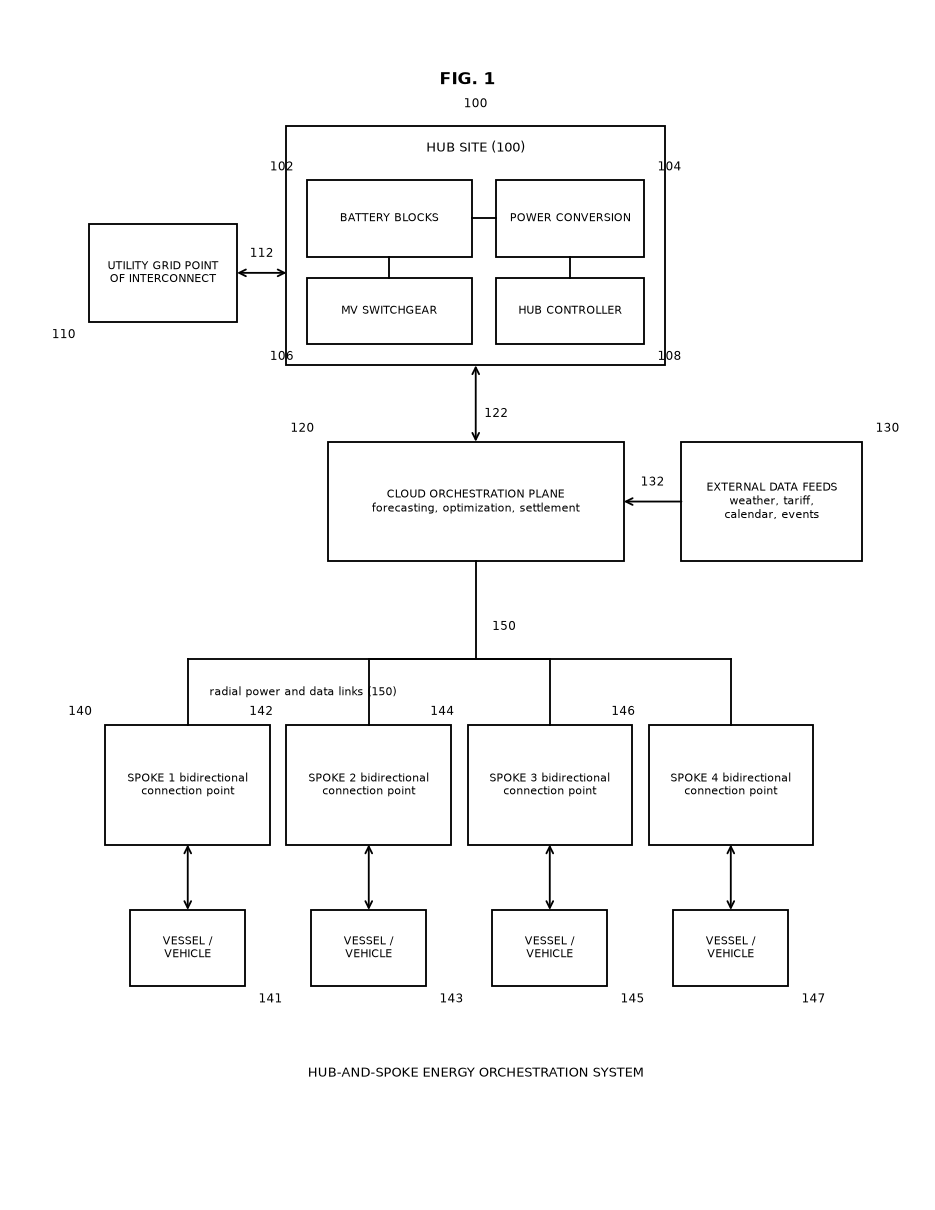
FIG. 1
Hub site and its spokes
Battery blocks, power conversion and switchgear behind one metered point of interconnection, with radial power and data links out to each spoke.
Your marina can be the hub or a spoke — both carry the same service guarantee.
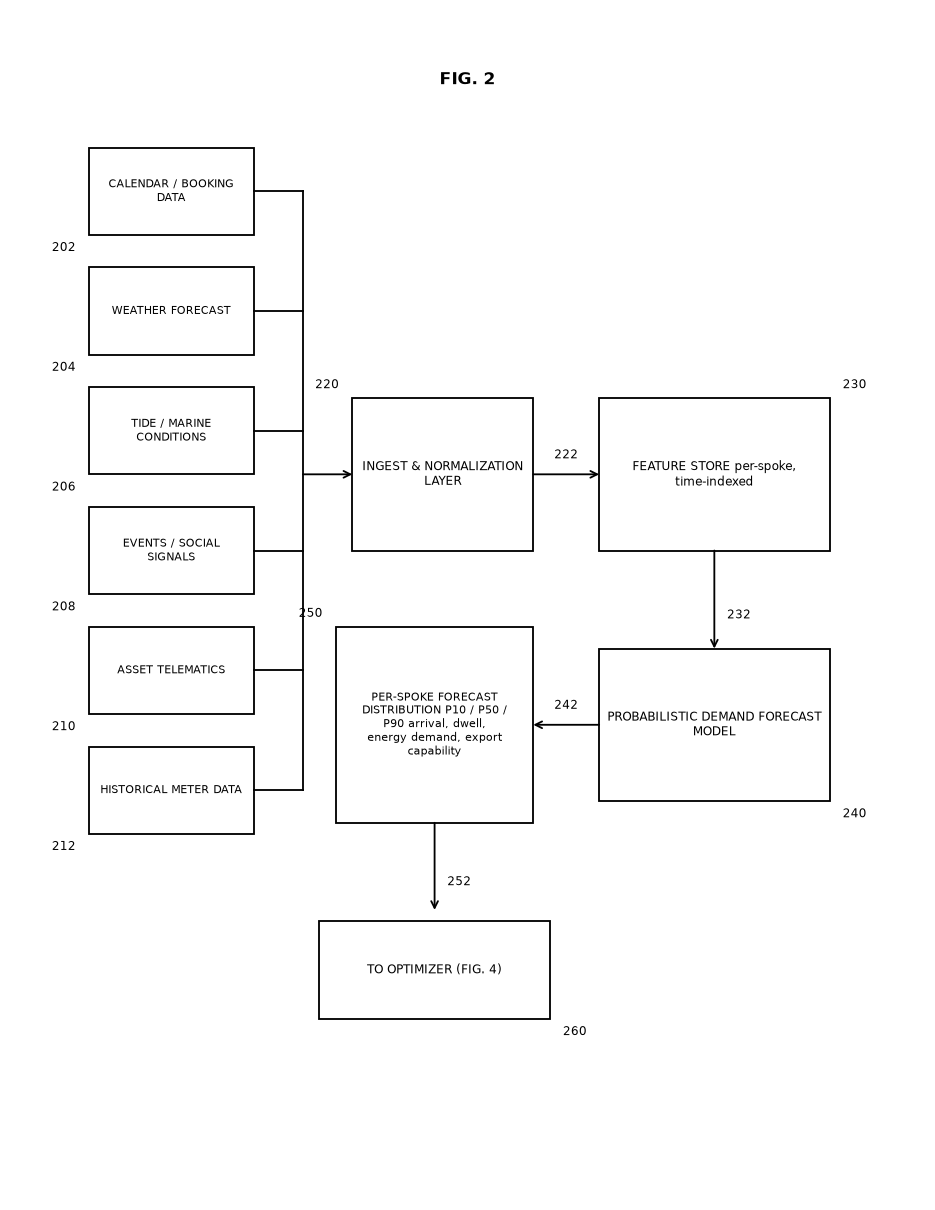
FIG. 2
Multi-signal demand forecast
Reservations, weather and marine conditions, event calendars, occupancy and historical interval data resolve into a probabilistic forecast for each spoke.
A holiday weekend, a storm shift or a fishing tournament is priced in before it hits your bill.
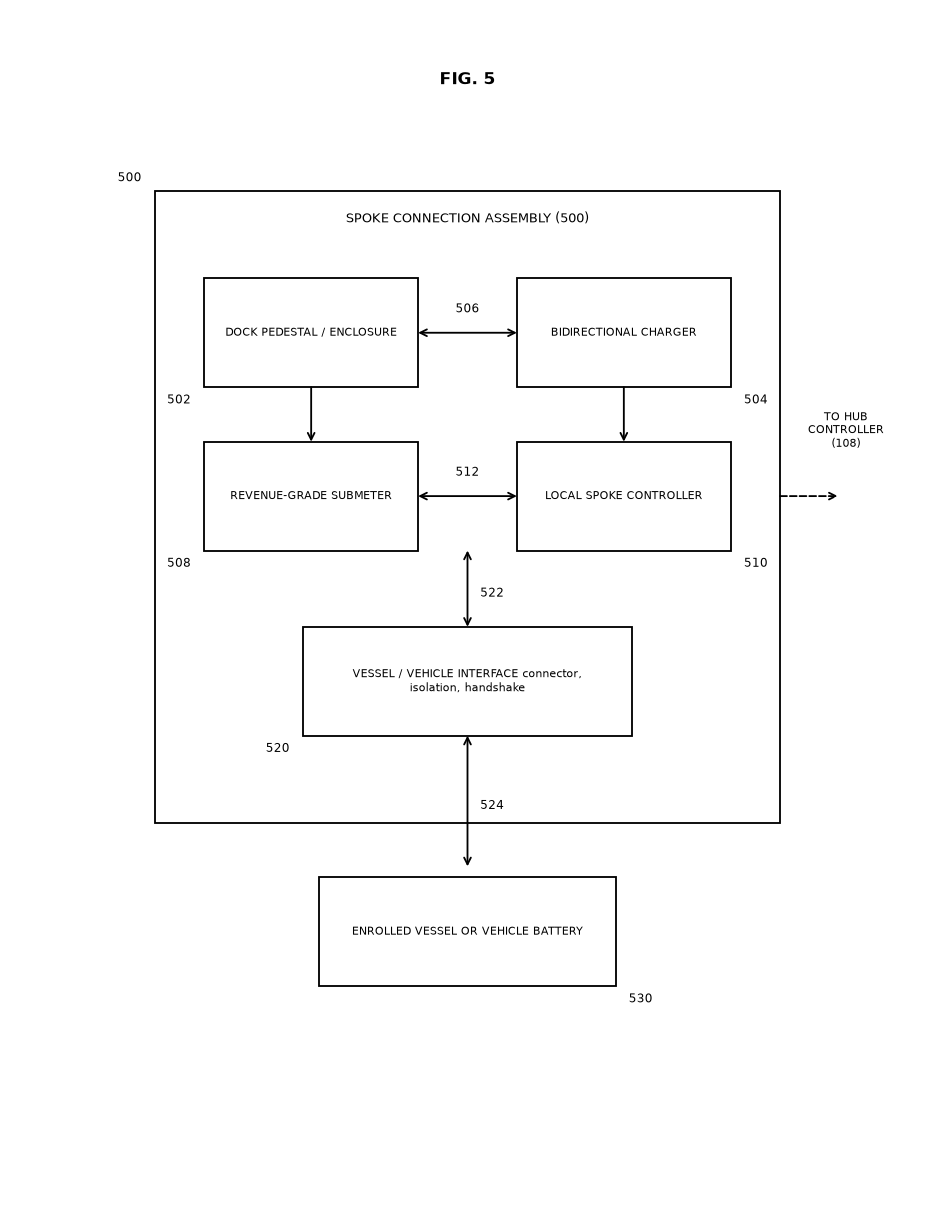
FIG. 5
Dockside spoke assembly
Pedestal, bidirectional charger, revenue-grade submeter and a local controller that keeps enforcing its limits even if it loses the hub.
Every kWh in or out of a slip is metered at the pedestal, so settlement is auditable.
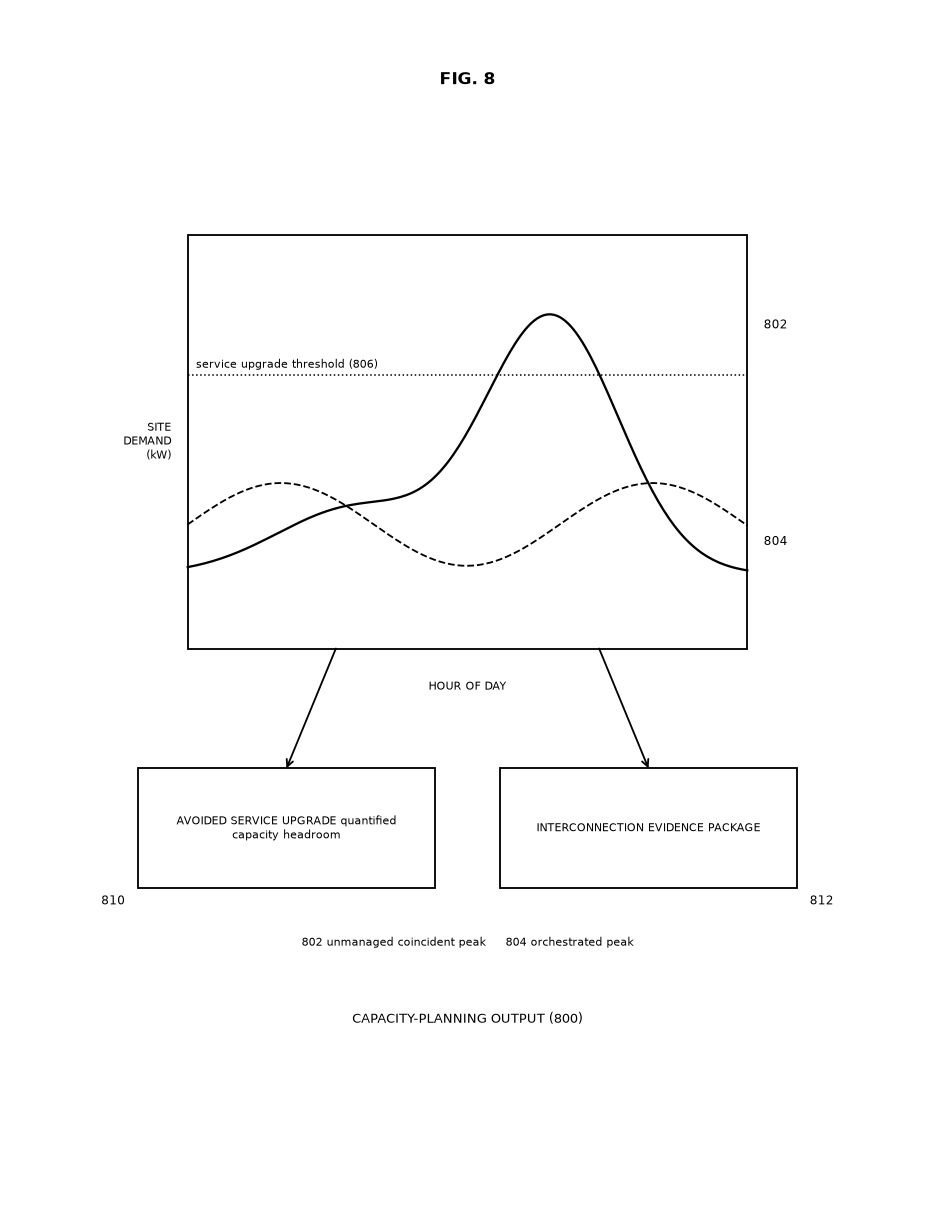
FIG. 8
Deferring the service upgrade
The orchestrated peak is held under the service threshold, and the record of it becomes the evidence package for the utility.
This is the difference between adding shore power and paying for a new service.
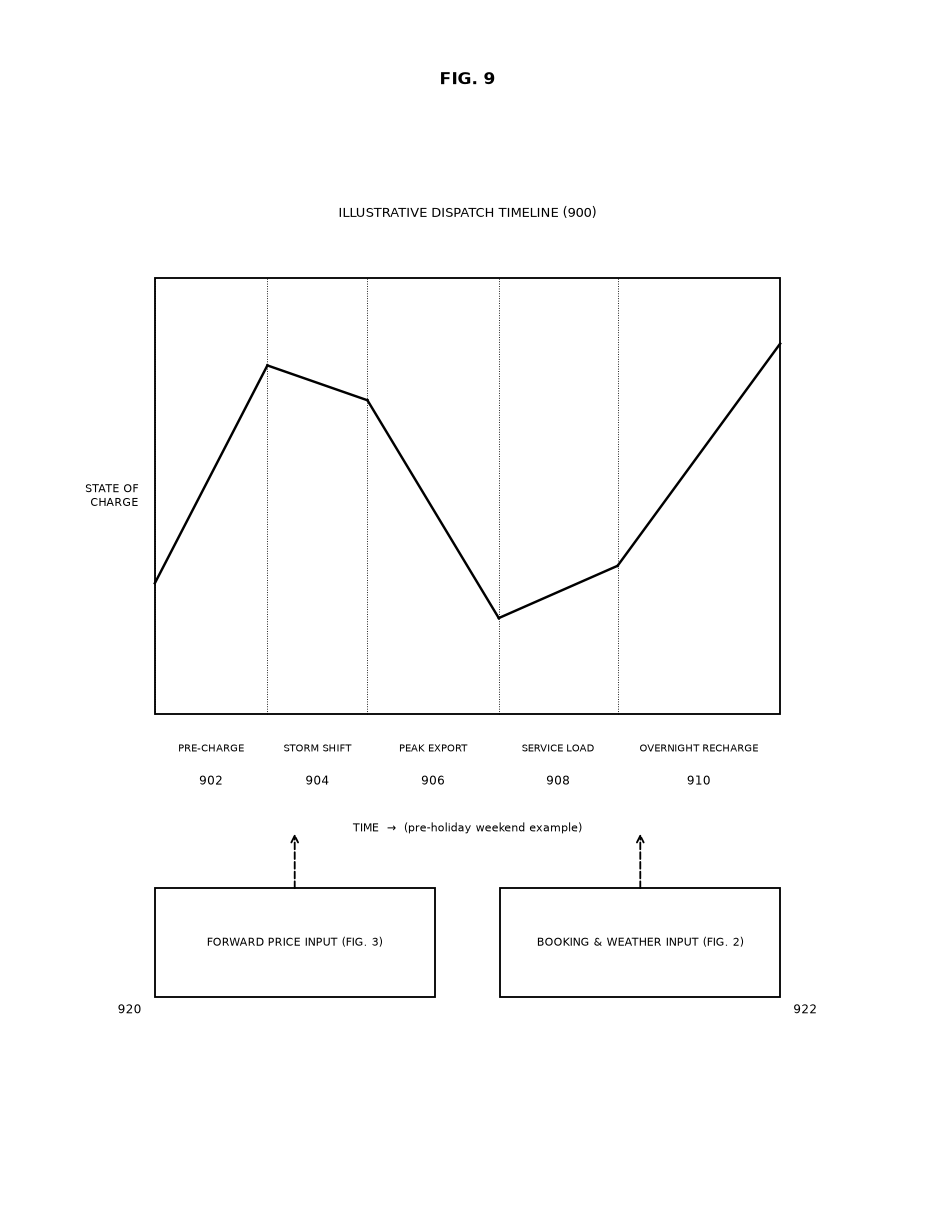
FIG. 9
A day of dispatch
Pre-charge, storm shift, peak export, service load, overnight recharge — set by forward prices and what the yard has booked.
Nothing for the dockmaster to run. The plan re-solves on a rolling horizon.
Claim scope as filed
Headings only — the full claim language sits with counsel. Each one maps to a drawing sheet you can see above.
Claim 1 · Hub-and-spoke orchestration system
independentFIG. 1 · FIG. 2 · FIG. 4 · FIG. 5
Claim 2 · Distributional forecast and peak-setting probability
dependentFIG. 2 · FIG. 3
Claim 3 · Third-party mobile batteries as dispatchable resource
dependentFIG. 5 · FIG. 6
Claim 4 · Tiered credit-back and fee-first waterfall
dependentFIG. 7
Claim 5 · Marine features in the load forecast
dependentFIG. 2
Claim 6 · Degradation cost in the objective
dependentFIG. 4
Claim 7 · Host service-level guarantee as a hard constraint
dependentFIG. 4 · FIG. 5
Claim 8 · Capacity planning and interconnection evidence
dependentFIG. 8
Claim 9 · Multi-hub aggregation into a single dispatchable block
dependentFIG. 10
Claim 10 · Method claim
methodFIG. 4 · FIG. 9
Claim 11 · Communications-loss fallback schedule
dependentFIG. 4 · FIG. 5
Claim 12 · Explainable forecast attribution and retained decision record
dependentFIG. 2 · FIG. 4
Claim 13 · SPV aggregation of owner-held vessel batteries into one registered resource
dependentFIG. 6 · FIG. 10
Claim 14 · Nameplate, expected and firm aggregate capability
dependentFIG. 2 · FIG. 10
Claim 15 · Versioned enrollment registry reconstructing asserted capability
dependentFIG. 6 · FIG. 7
Claim 16 · Battery exercise, conditioning and resting-state management
dependentFIG. 4 · FIG. 5
Claim 17 · Exercise cycles timed to be revenue-positive
dependentFIG. 3 · FIG. 9
Claim 18 · Cycle budget as a soft constraint and owner health reporting
dependentFIG. 4 · FIG. 7
Claim 19 · Hub realized as a permanent boost power bank facility, with satellite facilities behind a distribution constraint
dependentFIG. 1 · FIG. 11
Claim 20 · Forecast-driven siting and staged installed capacity
dependentFIG. 3 · FIG. 4 · FIG. 11
Claim 21 · Resilience term, reserved energy and islanding plan
dependentFIG. 3 · FIG. 11
Claim 22 · Permanent upgrade avoidance and charge-rate buffering
dependentFIG. 1 · FIG. 8 · FIG. 11
Claim 23 · Cohort-level wear equalization and stage-by-stage re-powering
dependentFIG. 4 · FIG. 9 · FIG. 11
How it fits the pilot sites
The goal is to select the five best qualifying sites across five different environments. Each one is chosen to put a different part of the filing to work in the real world, so what we end up with is a metered record behind the method rather than a description of it. No site is named or committed here.
| Environment | What it proves | Part of the filing it exercises |
|---|---|---|
| Independently owned marina | One hub battery behind a single metered interconnection, docks rebuilt and metered slip by slip. | Hub site, dockside spokes, demand-charge-first dispatch. |
| Municipal or authority harbour | The same build under public procurement, with the dispatch record produced as public evidence. | Recorded forecast attribution and auditable settlement. |
| Boatyard and winter storage estate | Heavy seasonal load with haul-out schedules feeding the forecast directly. | Bookings and calendar as forecast inputs. |
| Federal waterfront installation | A guaranteed service level held as a hard constraint, with a safe local fallback if the site loses communications. | Service level as constraint; islanded spoke fallback. |
| RV park estate | The spoke pattern away from water, showing the method is not marina-specific. | Spoke assembly and vehicle-battery enrolment. |
The five come out of the qualification screen — utility capacity, slip count and condition, host willingness and a clean interconnection path. Every host runs under a license to the method for the life of the lease, whichever environment they sit in.
What a host gets from it
A license, not a purchase
The lease carries the right to run your site on the proprietary method for its full term and every renewal. GridLynQ keeps the IP and the operating risk.
Performance we own
Battery performance and replacement stay on our side of the line. You keep your slips, your dockmaster and your service guarantee.
Your own numbers
Hosts log usage and model their rates in the marina host portal before signing anything.
Get started
Find out what V2G is worth at your property
Marinas, boat yards, and campgrounds: take the 2-minute eligibility quiz and get a tailored V2G plan with equipment, revenue, and interconnection steps.
No GridLynQ block is energized yet. Every figure shown is a modelled profile of a candidate site's conditions — speculative, not measured, and not a quote or a guarantee of results.